Businesses can accelerate the growth of shared mobility
Text Bavo BoutsenImage Autodelen.net

Shared mobility, in which users share the vehicles they use to get around, is on the rise. That is cause for optimism, as this trend offers many benefits for both users and society. The phenomenon is gaining ground, but a major breakthrough has yet to materialise. Bold choices in the business world could set the tone.
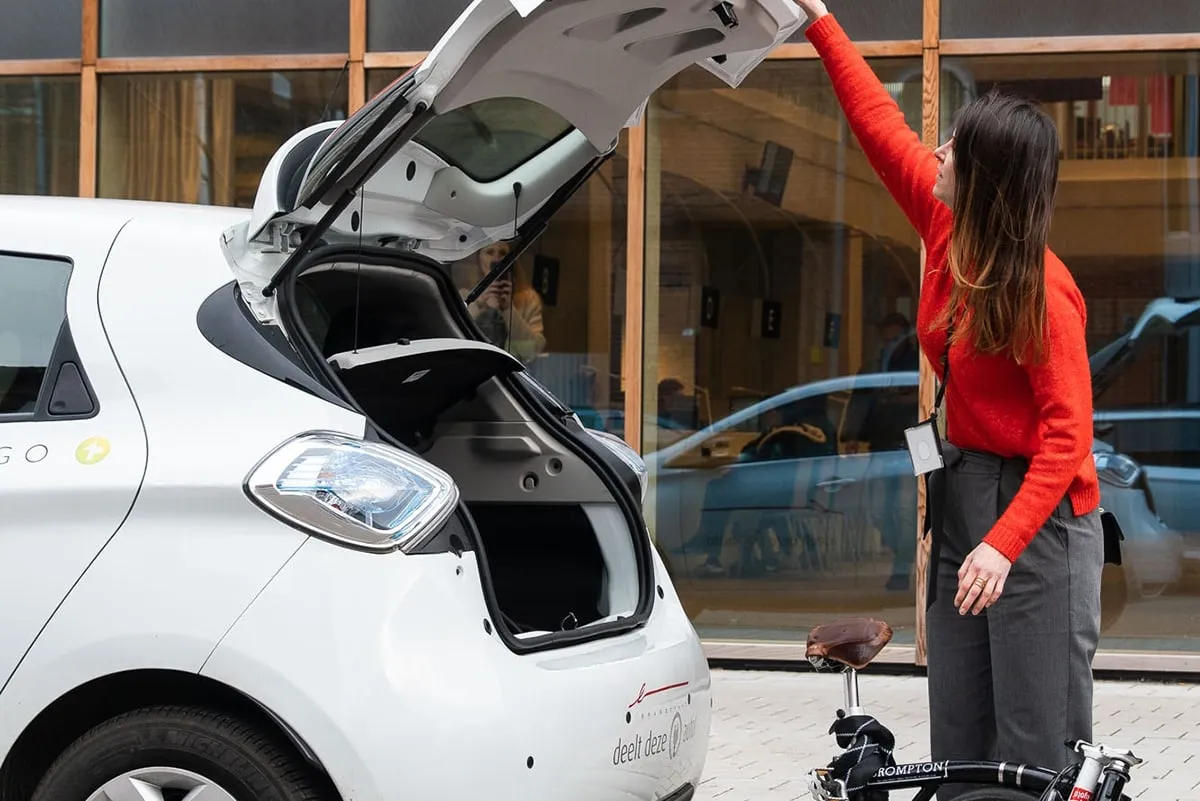
In recent years, the rise of shared mobility has clearly reshaped the streetscape in cities. A few years ago, shared e-scooters and bikes were still an occasional sight; today, they can be found on almost every street corner in major cities. The same trend is unfolding with car-sharing. In 2023, for example, car-sharing platform Cambio passed the 1 million-trip mark for the first time. Its distinctive cars with red roofs can now also be found in more than 100 cities and municipalities.
Market tensions
This growth reflects the broader shift towards a more climate-friendly society. “There is no doubt that shared use is part of the solution and that more and more people are recognising this,” says Jeffrey Matthijs, director of network organisation Autodelen.net. “In Brussels, for example, 10 per cent of driving licence holders already use car-sharing or have a subscription with a shared mobility provider.”
At the same time, some forms of shared mobility are also facing opposition. “What you are seeing now with shared bikes, and especially shared e-scooters, is typical market tension during the transition from a linear to a circular model,” explains Lieven D’hont, founder of Wij Delen vzw. The organisation campaigns for greater shared use in society. “Providers are primarily looking to gain market share. They do not handle materials carefully, so consumers do not either. Collectively, we still have a lot to learn.”
But the transition is under way, and policymakers seem to have recognised this too. “Our review of all the party manifestos ahead of the elections showed that every party cited shared mobility as an objective,” says Matthijs. “So they are building on the vision of recent years, with initiatives such as the so-called hoppin points and the basic accessibility policy. Shared use has a key role in both.”
The business world as a potential catalyst
Shared mobility is likely to see a fresh acceleration in growth in the coming years. The business world holds the key, says Jeffrey Matthijs: “Bold choices can set the tone. For example, we believe the mobility budget should become the norm, rather than simply replacing company cars or salary cars, as it does today.” The more businesses do, the greater their impact on the image of shared mobility. “The great strength of car-sharing is that it appeals to both the left and the right of the political spectrum. The left supports it for environmental reasons, while the right is particularly interested because it also offers more opportunities to use more expensive, exclusive cars,” says Matthijs.
Examples of initiatives that have already succeeded in this respect include Claus2you and ValckenierShare, launched by garage Claus in Zonnebeke and Valckenier in Aalst respectively. “Both garages realised a few years ago that the traditional garage business model would come under increasing pressure. They deliberately chose to enter this market.”
Inclusion must be the starting point
However, shared mobility must not be limited to the business world. There is also significant potential among groups outside the middle class. “Although shared mobility is currently mainly an urban phenomenon, it does not reflect the diversity of our cities,” says Hassan Al Hilou, founder of CAPITAL vzw, a social organisation working on diversity and inclusion.
“By failing to pay attention to diversity, shared mobility providers are missing out on many economic opportunities,” Al Hilou continues. “We therefore need to find ways to remove the initial barriers for people with less financial means.”
“In Ghent, for example, a pilot project is under way in which the city plays this role by providing financial support and personal guidance for users’ first trips with a car-sharing platform,” adds Jeffrey Matthijs. “In our new policy plan, which starts next year, inclusion will have a much more prominent place, enabling us to launch more initiatives of this kind.”
Question about this story? Ask your question
Keep following this
Get an email when a new story is published. No account needed.
- SubjectMobility