




“Some issues require the province’s scale”
Text Roeland Van Den DriesscheImage Carlos Lopez
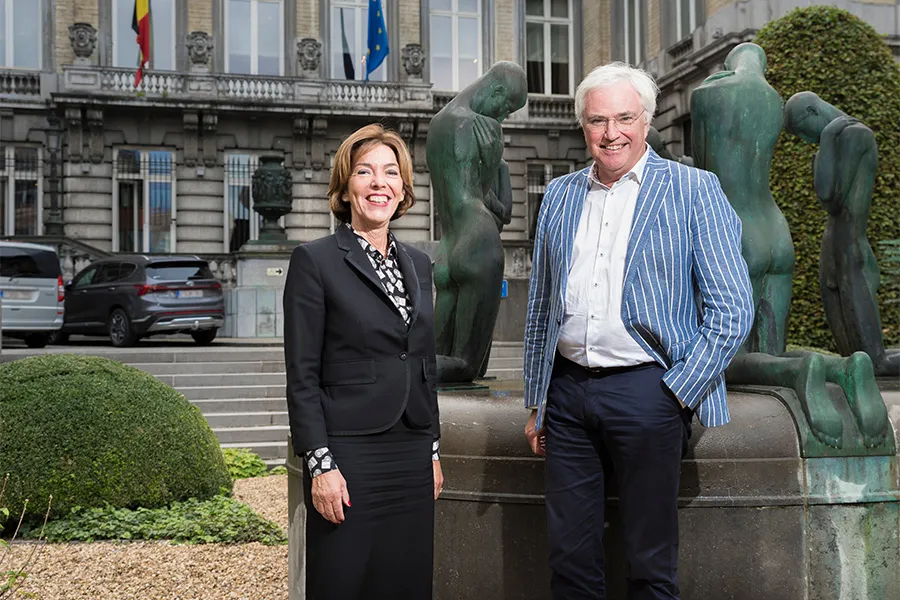
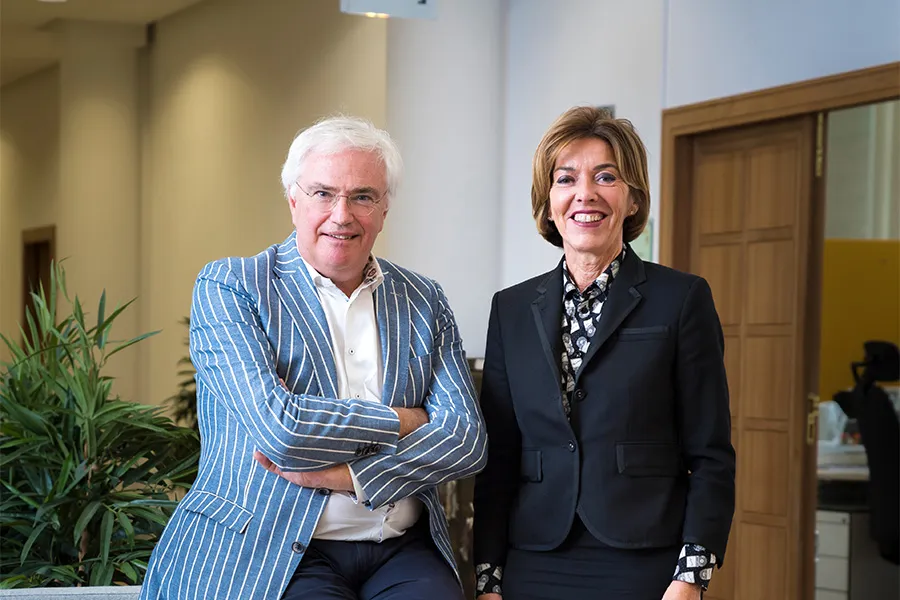
Double interview with governors Carina Van Cauter (East Flanders) AND Carl Decaluwé (West Flanders)
We are just over a year away from the local and provincial elections. For many, they still seem a long way off, but for local politicians they are fast approaching. Few know better than governors Carl Decaluwé and Carina Van Cauter what an election campaign can do to a politician. But today their hearts are with the province, and they wear the governor’s sash with appropriate pride. They have a clear view of the economy and are keen to play their part: “As governors, we can make a difference.”
As governors, you have a coordinating role in your provinces. Is there enough time to engage with businesses? And what challenges do you see for our businesses in the years ahead?
Carl Decaluwé: I make a point of visiting our businesses regularly, so I have a good understanding of the issues entrepreneurs are grappling with today. The West Flanders economy is in good shape. For example, the unemployment rate is very low. But the flip side is a severe shortage of workers and a lack of space for businesses to grow. Anyone looking for 40 hectares of industrial land today, for instance, simply won’t find it. Moreover, the nitrogen ruling has made it no easier to obtain permits. Through the provincial development agency, we are playing our part as a facilitator and seeking effective solutions for businesses.
Carina Van Cauter: We face the same challenges in East Flanders. And while many may think of us as West Flanders’ little brother, the figures tell a different story. We have the highest employment rate and lowest unemployment of all the provinces, and we are Belgium’s most competitive province. Years ago, we began shifting towards a more sustainable economy, particularly in the port area. That is now paying off. It is clear, though, that we still have work to do in logistics and infrastructure.
Mobility remains a concern for many businesses. Is there any improvement on the way?
Carl Decaluwé: We will have to wait and see. The budget allocated to environmental and infrastructure works has halved in recent years. The biggest drain on it is the Oosterweel connection. Don’t get me wrong, that work is necessary. But how long have we in West Flanders been calling for a third lane on the E403 between Roeselare and Bruges?
Carina Van Cauter: A number of projects certainly deserve more attention. In our province, for example, upgrading the ring road around Ghent, extending the N60 and improving access to North Sea Port, including the construction of a new railway link between Ghent and Terneuzen, have all been long-running projects. Fortunately, we are now seeing efforts to catch up. You should not underestimate the governor’s role in projects like these. We often manage to bring local authorities together across municipal boundaries and get them pulling in the same direction, helping the permitting process run as smoothly as possible.
Despite all the efforts, things still often go wrong. The Ventilus project is a case in point. Where did things go awry, Governor Decaluwé?
Carl Decaluwé: First of all, as governor I tried to build support for the initial report that was on the table. Initially, everyone backed it. But then, one by one, people suddenly changed their minds. The debate was handled completely wrongly, and an underground high-voltage line was never an option. I sincerely hope we can now make rapid progress, because the electricity we are generating on a massive scale offshore needs to be brought ashore to prevent a blackout in the longer term.
As governors, you also maintain many international contacts. How important are they?
Carl Decaluwé: I am fortunate to have regular opportunities to meet heads of government and leading business figures. I try to open doors for businesses looking to break into international markets. That is not always easy, but by first highlighting what makes us unique, such as our offshore activities off the coast, we can quickly spark interest in what else our region has to offer.
Carina Van Cauter: There is no doubt that fantastic things are being developed here. It is our businesses that put our region on the map. Our ports, too, are held in high regard around the world. Since the merger, North Sea Port has risen into Europe’s top 10 for cargo throughput, and ranks third for added value. The Waaslandhaven, meanwhile, is a growth hub for Port of Antwerp-Bruges.
You know your own province inside out. But how well do you know each other? What are each province’s strengths?
Carina Van Cauter: We have different DNA, but I am convinced that we complement each other and each have our own strengths. The blue cluster, which Carl had to fight to bring to Ostend, is one achievement I really admire. It is rightly a mainstay of the Flemish economy.
Carl Decaluwé: I associate East Flanders with the port of Ghent and Ghent University. In my view, a university is an inexhaustible source of new talent, and the fact that West Flanders has never had its own university remains a major handicap, even though KU Leuven and UGent are now active in our province.
What about the stereotypes: is the Kortrijk region still considered the Texas of Flanders? Is Ghent, which bills itself as a mecca for tech companies, living up to its calling?
Carl Decaluwé: South West Flanders is and remains a very wealthy region. We can be proud of that, because we have managed to reinvent ourselves time and again, moving from agriculture to the flax industry, then to a thriving textile industry and innovative agri-business. This restructuring took place almost entirely without government support. Admittedly, we did things our own way, but our entrepreneurial spirit has brought prosperity.
Carina Van Cauter: East Flanders can certainly hold its own. Last year, East Flanders start-ups and scale-ups raised no less than €391 million in venture capital, more than in any other province. All of Flanders’ digital unicorns, valued at over €1 billion, are based in Ghent. The work being done by our businesses is also attracting growing attention worldwide. So we are fully living up to our calling, and the triple helix, cooperation between government, businesses and research, has proved crucial. We must continue to focus on it.
There are rumours that these could be the last provincial elections, and that this level of government could be abolished afterwards. What is your view?
Carina Van Cauter: Centralising everything would not be a good thing. Certain issues simply require the scale of a province, and I still sense a great deal of support for that. Staff are close to the people, know the area and understand what is happening locally. That must be preserved. Whether this ultimately takes place at provincial level or at the level of a reference region is a political choice. Our work is also public-facing and has a visible impact on society.
Carl Decaluwé: Personally, I would be very sorry to see the provinces abolished, because there is excellent cooperation within them and everything is in order financially. The political issues that are unresolved today are mainly at Flemish and federal level. It is a shame, though, that our fate is not in our own hands.
It is clear that the province is close to your hearts. Would you ever consider returning to politics?
Carl Decaluwé: No, that much is certain. Politics has changed too much. Today, it is no longer about substance, but rather about minor incidents. In the past, the challenge was getting into the media; now the art is staying out of it. Besides, I am a hands-on person by nature, and I believe that as governor I can still make a real difference.
Carina Van Cauter: Everything has its time. I enjoyed being a member of parliament, but a return is no longer on the cards. As governor, you work across levels of government and party lines to find solutions. It would not be right, in my view, to return to party politics afterwards with the trust and information you have built up.
Question about this story? Ask your question
Keep following this
Get an email when a new story is published. No account needed.
- SubjectGeneral







