




Double interview with Nico Daenens (Group Daenens) and Christine Mattheeuws (HDI-Wij Helpen)
Text Björn CrulImage Tom Leentjes
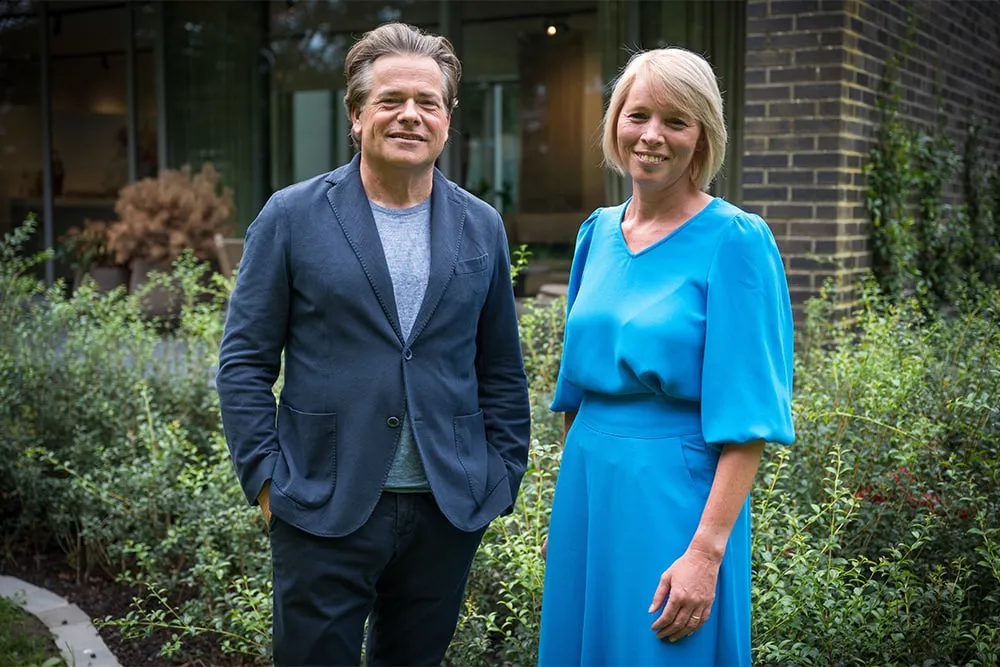
“SMEs need to be given much more scope to thrive”
Labour market pressures appear to be easing. VDAB figures show that the number of vacancies has been falling since the summer of 2022, while the number of working Flemings has risen steadily for 4 years and unemployment has stabilised. Has the labour market shortage peaked? And how can we tackle the problem in a structural way? These are the questions at the heart of a double interview with Nico Daenens, CEO of Group Daenens, which has no fewer than 16,000 employees, and Christine Mattheeuws, co-managing director of HR services provider HDI-Wij Helpen, which supports 6,000 businesses with their personnel policies.
Economic growth is slowing, and sectors such as construction, manufacturing and retail are going through a difficult period. Are you seeing an impact on the labour market?
Christine Mattheeuws: The picture is mixed. On the one hand, there are still a great many start-ups. But an increasing number of businesses across various sectors are struggling to meet their financial obligations. We are also seeing a record number of bankruptcies and closures, which are clear signs of an economic slowdown. In principle, this should make it a little easier for businesses to recruit. Yet our SME clients in sectors such as hospitality and construction tell us they still have to work very hard to attract new people. The challenge, then, remains to make more people available to the labour market.
Nico Daenens: Our group includes, among other things, a cluster of service voucher companies, which have recently begun operating throughout Belgium under the Daenens brand. Between them, we employ around 16,000 home helps. Finding enough people remains a daily concern, starting with covering for colleagues on maternity leave or off sick. We also need to replace older employees who are retiring. We know that home help is not the first job people aspire to. But those who do the job and realise it involves more than just cleaning enjoy it immensely. Human contact is very important. And we help older people to live at home for longer. We also take the pressure off families, giving them more time for other things. That social impact is very rewarding.
What needs to change to find a lasting solution to the shortage of talent?
Christine Mattheeuws: If we want to raise the employment rate further, we have no choice but to make work pay more. We need every talent, including older people, stay-at-home mothers and the long-term sick, to give the economy a boost. A bigger financial gap between working and not working remains the strongest incentive for people to roll up their sleeves. We also need to keep emphasising that having a job enriches your life, particularly through social contact. At the same time, employers’ labour costs, which are among the highest in the EU, need to come down.
Nico Daenens: The new governments absolutely must develop policies that give inactive people and the long-term sick greater incentives to re-enter the labour market. Additional financial obligations or penalties for businesses make no sense. Companies should be supported instead, and given the opportunity to engage and guide such candidates through appropriate tailored support. This needs to be considered sector by sector, and innovation will also be required. Positively incentivising inactive people and businesses is justified because activation reduces the costs of our social security system. And for our sector, employers and trade unions must continue working together to make the job more attractive. We need to do more than run campaigns: we must stand shoulder to shoulder to champion the profession of home help.
Social dialogue in the service voucher sector is currently a contentious issue. There is discontent among workers because employers have terminated the collective agreement on the end-of-year bonus. What happens next?
Nico Daenens: The issue is more complex than it seems. Social dialogue in our sector has been under intense pressure for far too long. No one wants to undermine employees’ social rights, but many service voucher companies are at breaking point because their costs are rising much faster than their income. Until 2022, the service voucher system only partially compensated for indexation of wages and general costs. And there is no additional income when wages rise as a result of further wage or social agreements. Since 2009, profitability has continued to decline: no fewer than 43% of service voucher companies made a loss in 2022. Meanwhile, the price paid by service voucher users remained unchanged. Inflation has therefore made our services cheaper in real terms. The new Flemish Government will need political courage to make the system fair again for everyone involved: our home helps, businesses, the government and users. Our sector creates value in so many ways, including job creation, tackling undeclared work and helping more people to live at home for longer. That social value must also be taken into account.
Christine, what are you expecting this autumn? What are HDI-Wij Helpen’s clients telling you?
Christine Mattheeuws: Employers are expecting a lot from politicians. They hope policies can be put in place quickly and that a business-friendly climate will be created. I did sense some optimism this summer. Hopefully, new measures will take into account that SMEs are the beating heart of our economy. Many sectors, for example, make use of flexible talent, such as flexi-jobs, older people who can earn unlimited extra income, and students who are being taken on more often. This can also help address the shortage of talent. But entrepreneurs are above all hoping for action to address the mismatch between vacancies and jobseekers, through a range of guidance and supporting measures.
Nico, if you could put one priority to policymakers for the next five years, what would it be?
Nico Daenens: I agree with Christine: SMEs need to be given much more scope to thrive. We focus too much on multinationals. Belgium is not carried by the ‘Googles’ of this world, but by the passion and ambition of small and medium-sized businesses. Give these entrepreneurs room to grow and support them with dynamic labour market policies, and an economic recovery will follow naturally. That is why the tax burden needs to come down, rather than everyone being taxed even more. Let’s reward the success of the many small, creative entrepreneurs who roll up their sleeves and create jobs.
Christine, you spent 20 years at the helm of the Neutraal Syndicaat voor Zelfstandigen (NSZ). Three years ago, you moved to the social secretariat HDI-Wij Helpen. How do you look back on that move?
Christine Mattheeuws: For me, it was a positive move. I enjoyed working for NSZ and was given many opportunities there. As the daughter of entrepreneurs who ran a food shop in Ghent, I have always had an entrepreneurial streak. When I was asked to lead the social secretariat HDI, it was an opportunity I couldn’t miss. It also brought together my interest in business law and employment law. It was also around that time that Nico Daenens invested in HDI and plans were under way to merge with Wij Helpen. It was a challenge I was keen to take on. As a medium-sized social secretariat, we play an important role in supporting SMEs with their personnel policies. We are close to employers and accessible, while also having the scale to keep investing in our people and in digitalisation.
Nico, over the past 20 years, Group Daenens has grown from a single service voucher company into a diversified group, also active in temporary employment, outsourcing, training and as a social secretariat. What are your ambitions for the coming years?
Nico Daenens: Our DNA is rooted in social responsibility: as an employer, we want to contribute to our employees’ wellbeing by offering quality work and good working conditions. We now have a range of expertise as a service provider in both B2C and B2B, and these areas will complement one another even more in the years ahead. We don’t want to be the biggest company, but the warmest. We are building a strong HR group step by step, together with all our talented people. Growing in a quality-focused way also means creating opportunities for career progression and personal development.
Our group is also the main sponsor of football club KRC Harelbeke. As chairman, I help the board to professionalise the club. We invest in the first team, but just as much in youth development. For me, it is a social and educational project: we teach young people to express themselves, work together and deal with winning and losing. That is why I see football as an opportunity for development for all teams, including women’s football and G-football. I hope we can challenge every player. Because if no one believes in you, you won’t take action.
Question about this story? Ask your question
Keep following this
Get an email when a new story is published. No account needed.
- ThemeAttracting and retaining people
- SubjectGeneral







