




A double interview with Jolyce Demely (Agoria) and Hans Maertens (Voka)
Text Bavo Boutsen & Björn CrulImage Boris Vermeersch
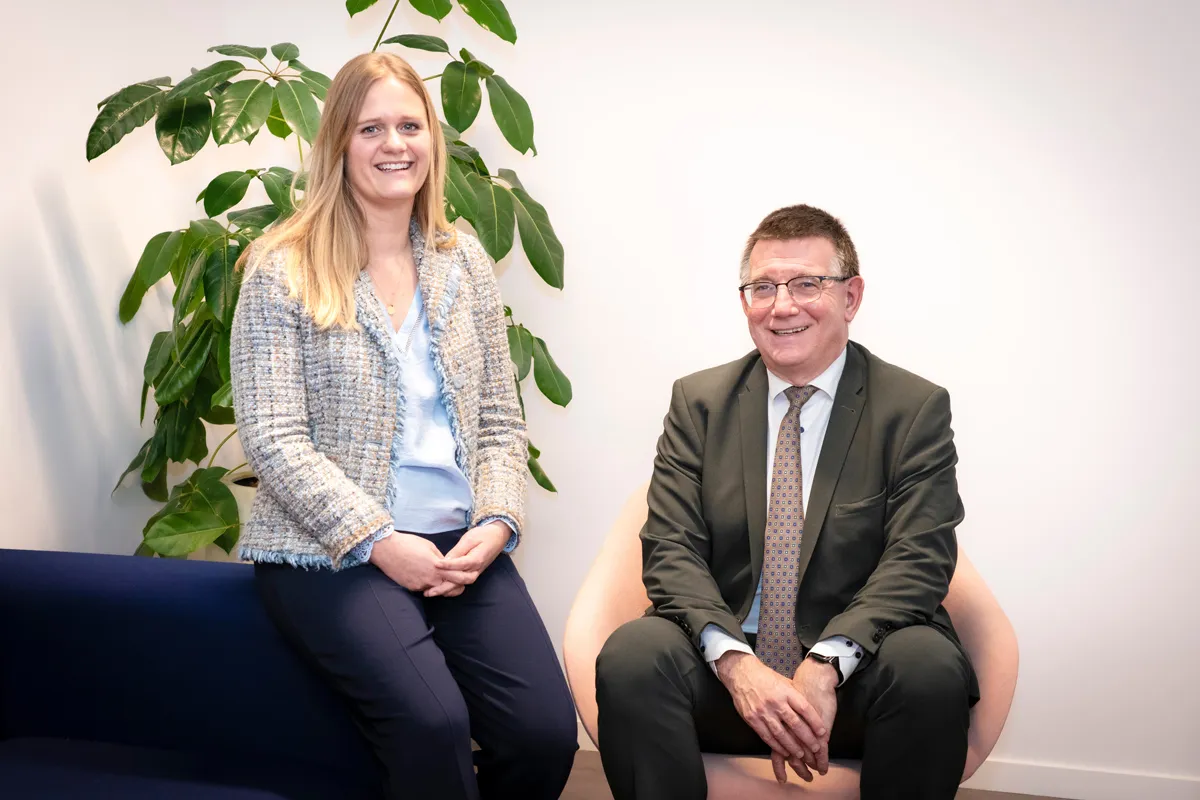
“The world is changing rapidly and we have to keep up”
With the 2024 election year approaching, Flemish companies are looking to the future more than ever. They have good reason to: we face major societal challenges, and structural reforms are therefore the only way forward. At the same time, the current economic climate calls for action in the short term, preferably before the elections. Voka chief executive Hans Maertens and Jolyce Demely, managing director of Agoria Vlaanderen, combine clear-eyed realism with a strong vision for the future. “Talent remains the decisive factor in a knowledge economy. Innovation is always about people.”
2023 was a year of mixed fortunes: Belgium has so far avoided a recession, but bankruptcies are peaking and some sectors, such as construction, are reporting a clear downturn. How do you assess the year?
Hans Maertens: It is indeed a case of mixed feelings. We are now feeling the after-effects of the Covid shock, which we initially recovered from quickly. But geopolitical tensions around the world are causing a new economic shock. The entire world order is under pressure: the balance of power between China, the US and the EU is clearly shifting. This is casting dark clouds over our economy. Our surveys show that businesses are very aware of this. One important indicator is the investment climate, which has unquestionably slowed. So this is not just a cyclical movement, but also a structural problem.
Jolyce Demely: We recorded growth of 6% in the first quarter. That has slowed to 2% today. What is striking, though, is that our sector is generating fewer jobs. This is down to the difficult economic climate. IT projects are simply put on hold more quickly when times get tough. As a result, the number of jobs in our sector has also fallen by around 1,500, and some of our people have been left on the bench through no fault of their own. This puts us at risk of missing out on a number of new flagship projects that help make Flanders what it is.
What was the most notable positive development in 2023?
Jolyce Demely: Without a doubt, the fact that production of the EX30, Volvo’s new electric model, was brought to the factory in Ghent. That is a real boost, especially when you consider how much work went into it. It shows that, despite the reality of high labour costs, we can still present Flanders to the market in a positive and attractive light.
Hans Maertens: Although I suspect 2023 will be remembered in the history books above all for its wars, I am still amazed and hopeful every day about the pace of technological progress. Combined with entrepreneurship, this is where the solutions to tomorrow’s challenges lie. Because we always want more, we tend to think everything is moving too slowly, but we underestimate what is being achieved. Just look at what our companies and researchers are doing in hydrogen, offshore wind turbines and, of course, AI.
Three issues keep cropping up among the companies we interviewed over the past year: a lack of space to expand, difficult permit procedures and a shortage of available talent. How can we tackle these problems structurally in 2024? Are there any quick wins?
Hans Maertens: The nitrogen agreement is a crucial step. So it is good that the entire Flemish Government is now working on it. Beyond that, the reality is that major reforms have been neglected. We are looking ahead to the next 10 years, or 2 terms of office, in particular, to implement fundamental reforms. The world around us is changing rapidly and we have to keep up, especially when we know that our pensions and social security risk collapsing if we do not take structural action.
Jolyce Demely: That is right, and that is precisely why we need to be more confident about showcasing our own potential. Our drive to innovate means we have a great deal to offer. Look at our materials cluster, our many Factories of the Future, or the international reputation enjoyed by imec. We are often too modest about this.
Will Flanders Technology and Innovation (FTI), the Flemish Government’s flagship project to showcase innovation in Flanders, help overcome this modesty?
Hans Maertens: We are fully behind it. As a student, I experienced Flanders Technology International, the major technology fair where we were introduced to robots, for example. People looked on with great admiration and pride. We have lost some of that today. In Flanders, we are effectively victims of our own modesty. We tend to question anything that takes courage.
Jolyce Demely: The plan’s objective is very laudable and is particularly important for young people. We need to show them that there are solutions to their concerns about the climate and the future, and convince them that they can make a difference by getting on board with technology and innovation. I hope schools will turn out in force for the various events.
2024 is an election year, with European, federal and regional elections in June, followed by local elections in October. Are you still expecting anything from policymakers?
Jolyce Demely: One very important factor is Belgium’s presidency of the Council of the EU, from January to the end of June. This is a window of opportunity that we must seize. We can see today that the EU’s Green Deal, which is intended to help industry transition to climate neutrality, is having disruptive effects. The major economic powers are providing massive subsidies, something we find much harder to do. That is why it is important for us to push for a more coordinated European approach to climate investment during our presidency, so that member states do not undercut one another. Otherwise, Flanders, as a small region, will be at a disadvantage.
Hans Maertens: The effects are already being felt. Just look at the many Flemish companies setting up across the French border. They are doing so because space and workers are available there, but also because they can access substantial subsidies. In other words, investment is shifting towards Europe’s larger countries. This once again shows how important the next two terms of office will be. Gouverner, c’est prevoir.
So the climate transition makes structural reforms even more urgent.
Hans Maertens: Exactly. These reforms are necessary, but politicians must also be willing to explain them. Reforming education, the labour market, pensions and social security will not be a neutral exercise, and will cost money for government, households and businesses alike. But in the long term, the transition will benefit everyone if we succeed in exporting more of our sustainable economic model. And we can do that! Just look at ZF Windpower and DEME, two companies helping to accelerate the global growth of wind energy.
Jolyce Demely: That is the message we want to convey too. That is why we are already working hard on an industry summit, which will take place at the closing event of Flanders Technology and Innovation. We want to present policymakers with a blueprint for the future of Flemish industry. It has a bright future, provided the right framework is put in place.
What is your number 1 priority for the next Flemish term of office? What should the next Flemish Government focus on first?
Hans Maertens: Without a doubt: innovation. We have to be willing to take the lead in the global transformation we are facing today. We should be aiming for a coalition agreement that embeds innovation in every policy area. I hope to see a coalition agreement with a spirit of innovation on every page.
Jolyce Demely: Absolutely. And it is important to recognise that innovation is always about people. Of course, we need technology, but we will not get anywhere without people. That is why I believe we also need a clear focus on lifelong learning, which we are still struggling to get off the ground. It should therefore become a fundamental objective, whereas today we too often see it as something secondary.
What was the last course you took yourselves?
Jolyce Demely: One on corporate governance, which is of course essential in my role as managing director.
Hans Maertens: And I recently took a course to improve my knowledge of AI. A fascinating subject!
Finally, what is your personal wish for the new year?
Hans Maertens: I hope the news can be a little more positive. That way, I can listen to the radio in the morning and start the day feeling more positive. The “Yes, we can” attitude might then come more to the fore.
Jolyce Demely: I completely agree. I often question how the media report on the changes taking place in the world too. They often seem too focused on scandals and not focused enough on what really matters for our prosperity. I also very much hope that we will have a new Flemish and federal Government before the end of next year, because that is simply essential given the enormous challenges we face.
Question about this story? Ask your question
Keep following this
Get an email when a new story is published. No account needed.
- SubjectGeneral







