Language services company Bellingua breaks down language barriers for SMEs and large companies
Text Anse KeisseImage Bellingua

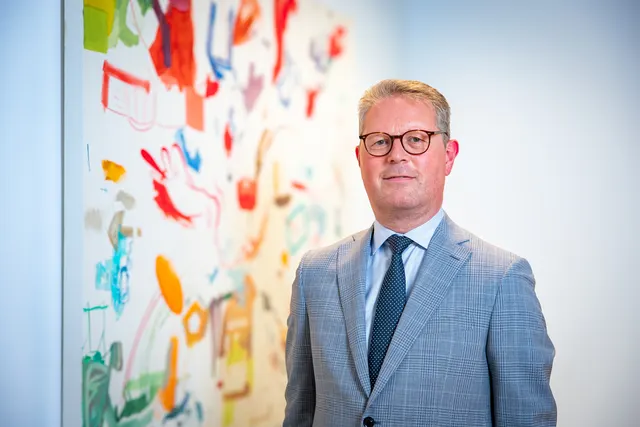
Companies with employees, customers or suppliers who speak other languages often encounter communication problems caused by language barriers. Bellingua removes those language concerns with translation, interpreting and copywriting, as well as targeted language training. “It is important for companies to integrate employees who speak other languages as smoothly as possible, while Dutch speakers also need to be able to express themselves in the language of the customer or supplier,” explains Nicolas Belpalme of Bellingua.
Nicolas Belpalme founded Bellingua with his wife, Griet Supply, in 2002. “My wife and I were both teachers. I also provided language training at a private company in the region. When that company closed, its customers asked if I could continue teaching them languages,” says Nicolas. “Local self-employed professionals also asked me if I could do translation work. That is how Bellingua’s services came about: tailored language training, translation, interpreting and copywriting for companies. Before long, those same entrepreneurs were asking if we could also help their children with languages, and even with maths and science. This led to a considerable expansion of Bellingua’s offering.”
Today, Bellingua is divided into B2B and B2C divisions. “As well as our services for companies, we also offer study support and language training for children,” says Griet, who is responsible for the B2C division. “We run our so-called language academies and language boot camps in Ieper, Kortrijk and Marke. Study support is available in Ieper, Roeselare or online. We work with both permanent employees and additional freelancers. In this way, Bellingua has grown steadily into the 20-person team it is today.”
Service without borders
With offices in Ieper, Roeselare and Lille, Bellingua is located at the intersection of the Paris-Brussels-Amsterdam and London-Lille-Luxembourg corridors. “Our services are not limited by national borders. Companies opening a branch in a region where another language is spoken, or selling their products and services there, benefit from communicating effectively in their customers’ language,” Nicolas explains. The most common languages are Dutch, French, English and German. “But companies also contact us for projects involving Italian, Spanish, Romanian or Polish.”
With unemployment low in Flanders, companies are increasingly recruiting workers from all over the world. “They therefore need to learn Dutch to understand safety and work instructions properly. Understanding and speaking the language used to communicate within the company also enables them to progress, follow meetings properly and manage colleagues,” Nicolas continues. “We also coach management teams to give presentations in another language.”
Personalised language training
The Bellingua training team develops results-driven courses. “First, we assess the profiles of those who will take the course, what their jobs involve, their starting level in the language and the client’s expectations. We then develop a learning pathway and agree on the method to use: in-person lessons or a blended learning programme, either individually or in a group,” Nicolas explains.
“We create training platforms tailored to each client, so people can learn and practise the language 24/7. A dedicated coach closely monitors each student’s commitment and progress. Individual coaching sessions take place every two to three weeks. During these sessions, students can explain the difficulties they have encountered, and the coach helps them prepare for the next part of the programme. The company’s HR manager receives regular reports, making it possible to clearly assess the ROI,” Nicolas adds.
Bellingua also works with companies’ HR departments to explore ways to reward students. This keeps them motivated and ensures they receive recognition from their colleagues and managers. “Ultimately, the Bellingua team is driven by a desire to strengthen people and organisations in a world where multilingualism is becoming increasingly important,” concludes Nicolas Belpalme of Bellingua.
Question about this story? Ask your question
Keep following this
Get an email when a new story is published. No account needed.
- SubjectServices