The benefits of AI for the machine-building industry
Text Roeland Van Den DriesscheImage Marelec, POM West-Vlaanderen, Sirris
Artificial intelligence: everyone is talking about it, but not every company dares to test or adopt the technology yet. Business Vlaanderen spoke to Sirris and POM West-Vlaanderen to find out why companies are holding back, and came across two early adopters, machine builders Marelec and Azumuta, who firmly believe in the technology’s benefits.
Industry 4.0 is bringing a host of technological advances to manufacturing companies. These include automation and robotics, as well as augmented reality, virtual reality, big data and the Internet of Things … But the word on everyone’s lips over the past year has been AI. Despite the hype, however, many companies are holding off on integrating the technology into their processes. “They see it as a potential threat, are worried about the cost, often don’t know where to start or where exactly the added value lies,” says Christophe Michiels of Sirris, the expertise centre for the technology industry.
Low-wage countries lead the way
Many companies have other pressing concerns at the moment, too. That is what Bart Verlinden of Sirris found in a survey of manufacturing companies. “Finding suitable staff is still top of the list. Employers are also concerned about their companies’ profitability. Many have yet to recover from the Covid crisis, and competition has only intensified in the meantime. The quality delivered by Flemish companies can now also be found in low-wage countries.”
Those very countries have spent the past few years investing heavily in innovation and automation. “We do see them adopting new technologies such as AI more quickly, particularly in handling and logistics. But that stands in stark contrast to the global supply chain, which is under pressure. This, in turn, is prompting many of our companies to take control of the supply chain themselves. To do so, however, they need to make it more efficient. AI can play an important role here,” adds Bert Vlaminck, cluster developer for machine building and mechatronics at POM West-Vlaanderen.



A wide range of applications
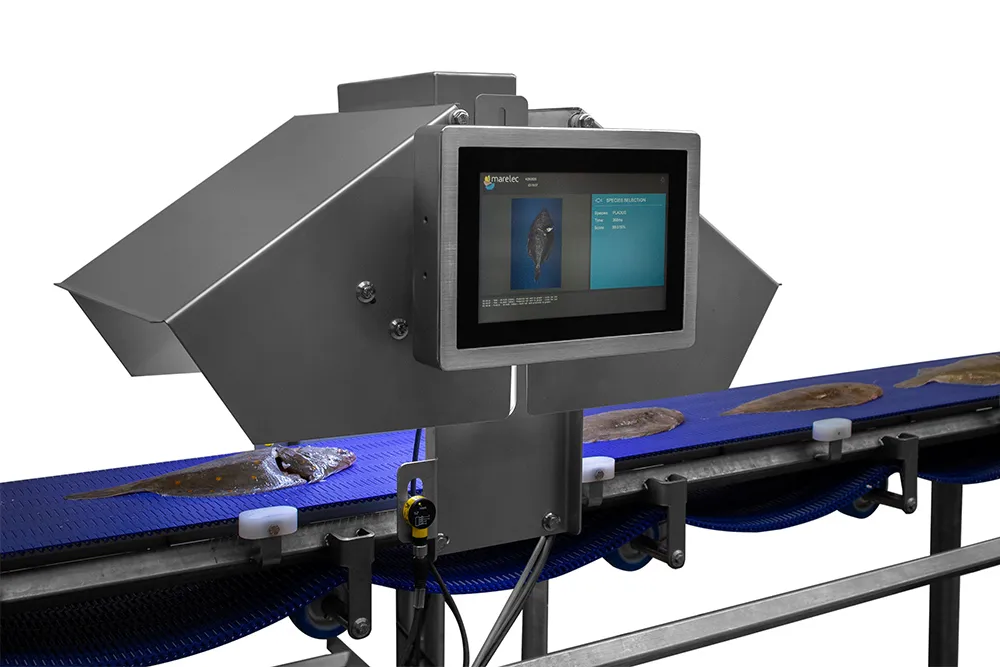
Artificial intelligence is a broad term. It includes machine learning and generative AI, which has made the technology accessible to a wide audience since the arrival of ChatGPT. Whatever the form, only a limited number of machine builders have invested in AI so far. One exception is Marelec in Nieuwpoort, which builds intelligent sorting and cutting machines. “We use a range of software techniques, including AI,” says Serge Defever of Marelec. “A good example is our latest development, the iVision. This machine extends an existing development that uses AI to sort fish by weight and species. It makes fewer errors and has an accuracy rate of over 98%.”
AI does not always have to be built into the machine itself to create added value. “Simply digitising your work instructions, training and quality checks can quickly boost productivity,” says Batist Leman of Ghent-based software scale-up Azumuta. “To this end, we have developed an integrated platform that uses AI to collect contextual information, so operators know exactly what to do and when. Our system also takes into account each employee’s expertise and the skills they need further training in. That is a major asset at a time when labour is scarce.”
The sector should not be afraid to experiment with AI. “Now is the time for companies to take their first steps. There are already plenty of good examples out there. Let them inspire you, and you will see that small changes can make a world of difference,” concludes Bart Verlinden.
Question about this story? Ask your question
Keep following this
Get an email when a new story is published. No account needed.
- ThemeDigital business and automation
- SubjectIndustry