The use of smart language technology is not without risk
Text Bavo BoutsenImage UGent
Since ChatGPT and generative AI first emerged, businesses have embraced smart language technology. So far, however, the wave of new possibilities has not been accompanied by collective awareness of the social and societal implications of these technologies. “More data is not necessarily always better,” say researchers at UGent.

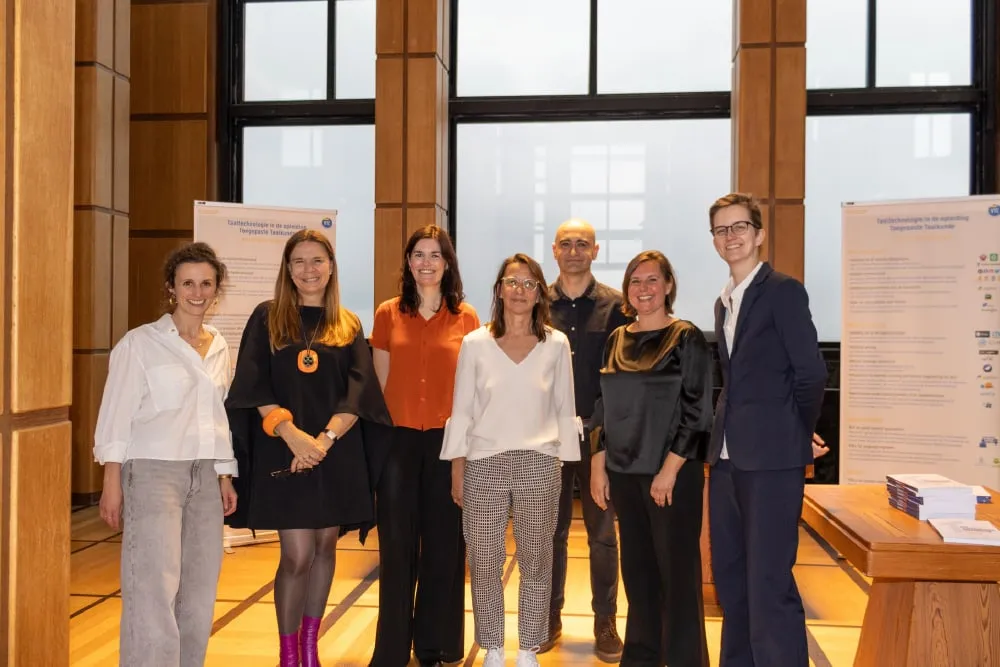
Generative AI is all about natural language processing (NLP) and large language models (LLMs). These groundbreaking technological innovations will have a particularly significant impact. At UGent’s Language and Translation Technology research group, this prompted the publication of the first Dutch-language overview of the technology, ‘Taaltechnologie ontrafeld: hoe taal en technologie hand in hand gaan’. The authors and researchers want to make language technology accessible to a wide audience by explaining how the system works, what applications exist, why these smart technologies are here to stay in our lives and what their consequences are for society.
A basic understanding is essential
“Despite the growing attention, there is no getting around the fact that the wider public still has little insight into what goes on under the bonnet of these technologies. That is why we deliberately wanted to write the book for a wide audience,” says Veronique Hoste, editor and professor of language technology at UGent. “People are particularly unaware of just how much data lies behind them, and how they are actually interacting with the technology when they use it,” adds editor and postdoctoral researcher Cynthia Van Hee. “Of course, not everyone needs to understand every technical aspect of this technology, but we believe it is important for people to have a basic understanding.”
It is particularly important to be aware of the implications when businesses start implementing artificial intelligence in their operations. “Take the screening of CVs by smart language models, for example. This can save a great deal of time, but the bias built into those models can also influence important decisions. Businesses need to be fully aware of that,” Hoste continues.

Side effects
A more fundamental problem is the lack of transparency. “NLP systems today essentially function as a big black box: you do not know exactly how they make decisions. That is problematic. The research community is paying a great deal of attention to this, but we find that the current methods for making these systems transparent are still falling short,” Van Hee explains. “New regulations, which are currently being developed at pace, must address this so that commercial applications can also become more transparent.”
Another problematic aspect of smart language technology, which has received relatively little attention to date, is its large ecological footprint. At a time when climate impact is helping to shape the direction of travel, particularly for businesses, that is striking to say the least. Veronique Hoste says: “The climate impact of a question asked of ChatGPT is about 10 times higher than that of a conventional Google search. Some even estimate that its energy consumption is up to 25 times higher, given the vast amounts of energy needed to train the technology, as well as the many natural resources required to build these systems. This is something that hardly anyone seems to consider. That is why we keep highlighting it.”

Embedding in society
The book is therefore not only a reference work on language technology, but also a call to take a critical look at how these technologies work and, above all, at the societal implications of using them. “This is a collective undertaking and the only way to embed them sustainably in society,” Hoste continues. “In the book, we tell the story of Tessa, the chatbot developed by NEDA, an American organisation working to prevent eating disorders. After an update, the system, which had previously worked well, began using generative AI to formulate its responses. Before long, it had to be taken offline because the chatbot was found to be giving inaccurate and dangerous advice, such as weight-loss tips. This incident shows that using more data and more powerful technology is not always better, and highlights the importance of collective awareness of technology, starting in primary education.”
Technology developers still too often seem to be motivated by a desire to prove what they can do, rather than reflecting on whether certain new smart language technologies are desirable. “New LLMs released today are generally always trained on even more data, even though that is not necessarily better for the businesses that will use them. In practice, we see that smaller language models trained on context-specific datasets can often perform better. That is why we need to push for more hybrid systems instead of ever more data, especially when you factor in the environmental costs of all these large language models,” the researchers conclude in unison.
Question about this story? Ask your question
Keep following this
Get an email when a new story is published. No account needed.
- SubjectHR, finance & IT