




Podcast with Vanessa Aneca & Annelies Volckaert on smarter investment in training and AI
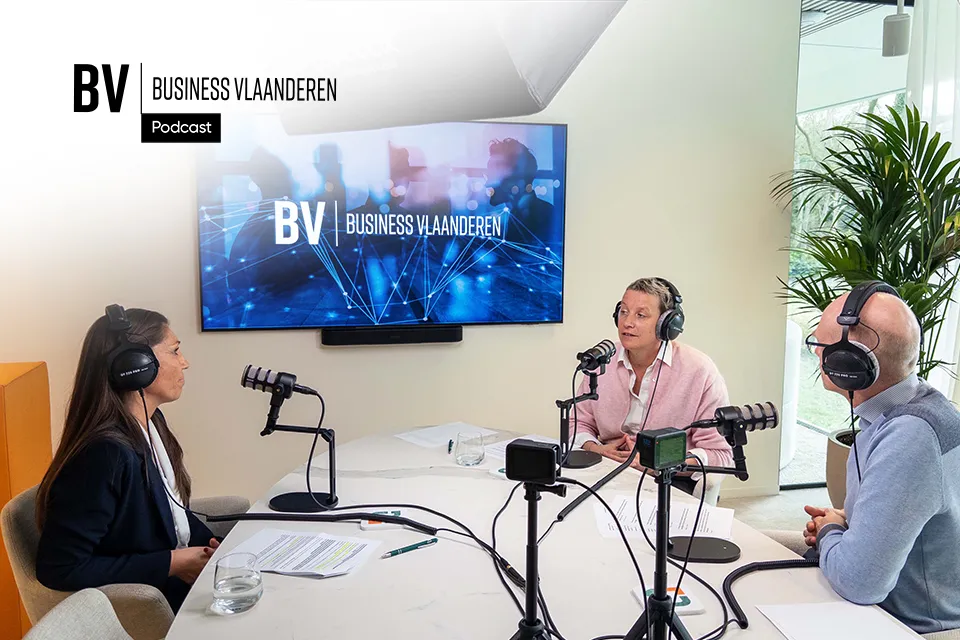
Host: Björn Crul
How companies can invest more strategically in training and AI
Amid economic uncertainty, companies are reassessing their investment in training and education. Yet learning & development remains crucial to retaining talent, improving performance and keeping pace with technological developments such as AI. What are organisations still investing in today? And how is the role of edtech and personalised learning changing? In this episode, we talk to experts in the field about the future of L&D in Flanders.


Full transcript
Alle hoofdstukken (55)
- Podcast introduction and topic
- SBM as a broad-based training partner
- Introducing EdTech Station
- Network, research and internationalisation
- Flanders’ position in EdTech
- The quality of Flemish EdTech
- Examples of companies
- Leading EdTech companies
- Economic conditions and cost-cutting
- More considered investment in L&D
- Investment in EdTech
- Reskilling and technological pressure
- Companies under pressure from AI
- Adapting to the new reality
- What companies are investing in today
- Technical programmes and skills development
- Drivers of continued investment
- Talent, performance and change
- Investment in EdTech and learning trends
- Blended learning and tailored programmes
- Impact of investing less in training
- Long-term consequences
- Government pressure and new ways of learning
- Expansion into the HR domain
- From learning to HR tech
- Role in HR tech
- Focus on competencies and technology
- Types of companies in HR tech
- Recruitment and competency matching
- Need for AI training
- Gap between potential and use
- AI’s impact on the EdTech sector
- AI as an accelerator and strategic challenge
- From knowledge to skills
- Focus on application and context
- Example of a tailored programme
- Tailored technical training
- Training outcomes and buy-in
- Research and personalisation
- Personalisation, data and ROI
- Data and the value of EdTech
- From gut feeling to measurable impact
- Technology versus traditional training
- Combining people and technology
- The role of trainers in a digital context
- Collaboration between technology and trainers
- Keeping a finger on the pulse of customer needs
- Identifying needs and staying in touch with clients
- Guiding clients where needed
- Looking beyond the initial request
- The future of learning & development
- A strategic role and rising expectations
- EdTech’s vision of the future
- Embedding L&D in strategy
- Closing remarks
Podcast introduction and topic
Björn Crul: Hello, listeners, and welcome to the Business Vlaanderen podcast. As in our magazine, we keep our finger on the pulse of trends and developments in the Flemish business community. Amid geopolitical conflicts and economic uncertainty, quite a few organisations are tightening their belts. This is reflected in lower spending on areas such as marketing, research and development, and certainly also on training and education. In this podcast, we focus specifically on learning and development. Keeping up with technological developments and lifelong learning are, in principle, high on the agenda. Are these ambitions coming under pressure? And what are companies that are still investing choosing to focus on? I’ll be discussing this today with Vanessa Aneca, learning and development adviser at SBM, and Annelies Volckaert, Head of Research and Innovation at EdTech Station. Welcome to you both. Vanessa, let me start with you. You work for SBM, an organisation that supports companies with coaching and training. What are the main areas you cover? When you look at SBM, we are
SBM as a broad-based training partner
Vanessa Aneca: essentially a broad-based training partner for organisations. We run both open courses and bespoke in-company programmes. As an L&D adviser, I mainly handle the in-company programmes, working with clients every day and sitting down with them to identify the solutions they need to develop their people effectively. The needs can vary widely. Sometimes it starts with a specific training request, but very often we need to take a step back. We then use a screening or analysis to identify the actual needs. From there, we develop a personalised, bespoke programme. This can combine different approaches, including training in the traditional blended format, coaching and, where necessary, practical support on the job. The subject matter ranges from very practical areas, such as technical training and mandatory safety courses, to languages and communication, as well as broader topics such as leadership. And, of course, the impact of AI and digital skills is also very much part of the picture.
Read the full transcriptCollapse transcriptnog 53 hoofdstukken
Introducing EdTech Station
Björn Crul: Yes, we’ll certainly come back to that shortly. Annelies, you work for EdTech Station, the innovation hub that brings companies and researchers together to explore developments in educational technology. What role does the hub play?
Network, research and internationalisation
Annelies Volckaert: Belgium, and Flanders in particular, is known for its educational technology. There are 400 companies in Flanders working in or developing educational technology. We aim to bring this network and its companies together to foster collaboration, because we see that training challenges are very rarely confined to one small niche. They often involve bringing together a great many different elements. We work on innovation and research because, if we want training and education to be firmly embedded, we also want them to be evidence-based and grounded in science. We also support our companies with internationalisation. Why? Flanders is, and remains, a small place in the world. If we want our companies to grow, it’s very important that they take the step abroad quickly.
Flanders’ position in EdTech
Björn Crul: The figure you mentioned is quite impressive, I think. 400 companies working in educational technology. Does that mean we play a significant role in Europe?
The quality of Flemish EdTech
Annelies Volckaert: Absolutely. Not just because of the number of companies, but also because of their quality. Flanders is a knowledge region. That’s said not only about educational technology, but about many sectors, and we see it very clearly in educational technology too. Companies are developing high-quality products that are well supported by evidence and address needs that matter not only in Flanders, but around the world. Our companies have an international reach. They are often smaller businesses, start-ups, scale-ups, as well as established names.
Examples of companies
Björn Crul: Which companies, for example, are already major international players in L&D technology?
Leading EdTech companies
Annelies Volckaert: Some companies are genuinely very large. One established name you might not immediately associate with training and education is Televic. Televic has an educational division that focuses strongly on assessment and certification. Its product is called AssessmentQ, and it’s a very impressive product. Another company based in the Ghent area, Flowsparks, for example, has some excellent solutions used worldwide to help organisations decide how to deliver their training. But there are also very different, much smaller companies, such as Linguineo. It provides language training based on spoken language, both for Flemish people going abroad who need to learn languages and for newcomers from other countries who arrive here and need to learn Dutch quickly.
Economic conditions and cost-cutting
Björn Crul: Let’s talk about the economic situation. The reason I brought you both together is that the economy is slowing, and we hear that companies are cutting costs. Are you seeing that in your sector too, with companies thinking more carefully and tightening their belts? Vanessa?
More considered investment in L&D
Vanessa Aneca: Yes, definitely. What we’re seeing at SBM is not that companies are stopping investing in L&D, of course, but that they’re making more considered choices, particularly in the current economic climate. Budgets are under pressure, so companies have to be more careful with their spending. For example, we’re seeing less spontaneous uptake of our open courses, the ones on our open course calendar. Demand is shifting towards bespoke training, with a clear focus on impact and practical application in the workplace. We’re also seeing more and more of what I’d call ‘nice-to-have’ courses being cut. Companies are putting greater emphasis on programmes linked to their actual business needs. They’re quicker to ask whether something really fits their context and what it will deliver in practice. Talent is also becoming scarcer, so investing in people is a necessity for many organisations. For us, then, it’s less about investing more and more about how companies can use their available budgets to deliver tangible results for the organisation. That’s where we’re seeing a shift.
Investment in EdTech
Björn Crul: Annelies, are you seeing that in investment in EdTech companies too?
Reskilling and technological pressure
Annelies Volckaert: Yes and no. On the one hand, a tight labour market also creates a lot of opportunities in training and education. Why? Once companies have people on board, they’d rather not let them go, even if the content of their jobs changes. So they’re reskilling people within the organisation to make the most of the talent they have. The reskilling market is really important. Then, of course, there’s the rapid pace of change, especially in technology. There’s no need to explain that, and I suspect the word AI will come up several more times here. AI has changed a lot of jobs, which means many people need to be trained differently. Companies need to consider how they can embrace AI to a certain extent, while also looking at how people need to be retrained.
Companies under pressure from AI
Björn Crul: That’s the opportunity side of the edtech sector. Which companies you’re in contact with are finding things tougher at the moment?
Adapting to the new reality
Annelies Volckaert: Companies whose solutions are now being superseded by AI. Some companies, for example, had used forms of machine learning to enable fast search functionality in their products. AI caught up with that in just two days. Companies that can’t make the switch, or that were too late to realise how overwhelming this development would be, are struggling. They really need to transform and find new ways of achieving what they set out to do.
What companies are investing in today
Björn Crul: Vanessa, looking at the investments that are being made, what training is in demand today? What are companies choosing to invest in?
Technical programmes and skills development
Vanessa Aneca What we are seeing very clearly today is that companies are focusing on things that help them move forward in their day-to-day operations. A very good example is our technical training programmes. They are currently seeing a huge surge in demand. Companies are finding it difficult to find the right candidates, so they often choose someone with potential and train them further themselves. In those cases, we usually start with a technical screening to map out the candidates’ competency levels. This gives us a very clear picture of where they are now and what their actual needs are. From there, we develop a bespoke technical programme that fits the company’s context and the participants’ skill levels. We also have our own industry campus, Connect, in Kortrijk, where we can organise these technical programmes for companies in a very practical way. And, of course, we are also seeing the growth of AI and digital skills. That makes sense. We are also noticing differences in levels of maturity. Some are still at the awareness stage, while others already want to take a much more targeted look at what they can do with these tools in a specific role. And leadership and everything related to communication will, of course, always be very important for organisations to ensure their teams continue to function well.
Drivers of continued investment
Björn Crul Is that one of the main reasons why companies continue to invest in their people?
Talent, performance and change
Vanessa Aneca Yes. One of those drivers is talent. You have to attract people, but of course you also have to be able to retain them. And then there is performance. Companies are looking for ways to make their people stronger and more efficient. There is also the need, as you will certainly know, to keep up with all the changes. AI, for example, is a very important factor, and people need to stay abreast of all the changes taking place in the world.
Investment in EdTech and learning trends
Björn Crul Annelies, I saw you nodding. Are the reasons for investing in edtech applications broadly the same?
Blended learning and tailored programmes
Annelies Volckaert Yes, although there are probably some differences. We are seeing courses and training increasingly delivered in a blended format. The approach is to combine technological applications with on-the-job training, often one-to-one, because classroom training is disappearing. We are seeing it decline further and further. That is also what we are seeing at SBM: tailored programmes are becoming very important, as are technical and technology-focused programmes. Technology is responding to that too. A lot of it is now about designing tailored programmes for companies based on their existing business processes. How can we upskill and reskill people in those processes, but also simply introduce them to a role? That is where quite a few challenges lie.
Impact of investing less in training
Björn Crul On the other hand, there are companies that are becoming more cautious with spending, or perhaps even putting training and development on the back burner for a while. The question, of course, is what the long-term impact of that will be. How do you look at it? Can that impact be assessed?
Long-term consequences
Vanessa Aneca The impact is not immediately visible, of course. It only becomes apparent in the long term. Cutting costs may seem logical in the short term, but then you suddenly notice that teams are less up to speed with new tools, that they receive less support in their roles and that performance comes under greater pressure. Companies that continue to invest are building a lead because their people keep growing. So I think the true cost of not investing only becomes clear later. But by then it will also be much harder to make up the ground.
Government pressure and new ways of learning
Annelies Volckaert I think you are absolutely right. What we are seeing is that people are looking for ways to speed up training. They often try to do that digitally. We are a little cautious about that. Digital tools can help, but they are certainly not going to solve everything. That is one side of it. On the other hand, we are also seeing pressure from the government, which has made talent as a resource one of its major policy priorities. It is well aware that the labour market is facing a shortage and that we need to address it. So on the one hand, there is pressure from the government to invest in this. Companies say they have too few people, so it is not just resources they lack, but also the time to organise training and development. New ways of delivering training are now being developed in response, and that also creates an opportunity.
Expansion into the HR domain
Björn Crul I think you have made a very important point there, namely the priority the government gives to training and development, but also the wider field of everything HR encompasses. To the extent that your remit as EdTech Station is being expanded.
From learning to HR tech
Annelies Volckaert Until now, we have focused solely on training and development. So, technology related to the design of training, both in education and in business. But we are increasingly seeing that it is a link in a wider chain. As you said earlier, it starts with identifying which competencies we need and goes all the way through to managing those competencies and determining whether we have them in the company. How can we train people, how can we retrain them, but also how can we keep them happy in their jobs? That is another very important aspect. If people no longer feel that they can grow, problems arise and they leave. The real resource is not finding people who work elsewhere. It lies in helping your own people move from the shop floor into roles that genuinely benefit both the company and the employee.
Role in HR tech
Björn Crul So that means you will also be supporting the whole HR tech space, if I may call it that?
Focus on competencies and technology
Annelies Volckaert Particularly the content side of HR tech. We are not looking to cover payroll administration at this stage, but everything related to competencies and the technology being developed around them will be part of our network.
Types of companies in HR tech
Björn Crul What kinds of companies are active in that field?
Recruitment and competency matching
Annelies Volckaert Very often, these are also companies involved in recruitment. Why? As soon as people enter a recruitment process, whether they are candidates looking for a job or a company looking to hire, competencies are immediately part of the picture. What are we looking for? Which competencies do we need? How should we go about this? Does an applicant meet those requirements? Technology is now often used to screen candidates and determine that, OK, they meet the requirements but are missing certain competencies. That means we can set up a training programme to develop those competencies. So you can see that it really is a link in a wider chain.
Need for AI training
Björn Crul Let’s talk about AI. It has already come up a few times here. It is a real game changer, including in learning and development. Are you seeing strong demand for courses and training specifically focused on AI?
Gap between potential and use
Vanessa Aneca Yes, absolutely. What we are seeing among our clients is that many organisations already have access to AI and are actively experimenting with it, but the real challenge is using it efficiently and thoughtfully. There is a very clear gap between what is technologically possible and what people actually do with it in their jobs. That is a major difference we are seeing, as well as varying levels of readiness, as I mentioned earlier. Some are still at the awareness stage, while others want to explore specific applications in much greater detail. For example, what can AI do for a particular team or role? So the question is sometimes less about the tool and more about how I can create value with it. So yes, there is definitely a need for training, but I think what matters most is providing guidance to help people translate it into practice.
AI’s impact on the EdTech sector
Björn Crul Annelies, you touched on this earlier. You said a number of companies in the EdTech niche are struggling because they are being partly overtaken by AI. How do you see things developing for the 400 companies in that ecosystem?
AI as an accelerator and strategic challenge
Annelies Volckaert We are seeing a number of things. First, some companies have clearly embraced AI. Why? AI can speed up a number of processes, from expanding the range of content that needs to be created and producing genuinely tailored content, to very simple tasks such as translating training materials quickly and effectively into many languages in a practical and usable way. We had translation tools before AI, but Google Translate five years ago is absolutely not what it is today. So we are seeing developments there too. But I also agree with what you said. We are very much aware of the need to focus on AI awareness, including among CEOs. We often hear this, not from EdTech companies, but from people looking for training and development: “Yes, but we have a co-pilot in our company, so we are keeping up.” And then the question is, OK, but what do you actually want to do with AI? Do you want to speed up your processes with it? Do you want to use it almost like a gadget to carry out a few tasks? Do you want to use it to replace people? These are all questions that you really need to address with your CEOs at a strategic level. What does AI mean for you? It goes far beyond the large language models we are always talking about.
From knowledge to skills
Björn Crul Another major trend in L&D is the growing emphasis on skills over knowledge. And that brings us straight into your field, Vanessa. It is no longer just about knowledge, but about the ability to put that knowledge to work and apply it in practice. What does that mean for the training programmes you offer?
Focus on application and context
Vanessa Aneca For us, it mainly means a shift in focus towards what people actually need to be able to do in their jobs. We are now receiving many more requests for targeted programmes, both individual and group-based, where practical application is at the centre. At the same time, we always take a broader view of the individual. It is important to start from the company’s context and the objectives linked to it.
Example of a tailored programme
Björn Crul Can you give us a specific example? What kind of training have you worked on very specifically with a company?
Tailored technical training
Vanessa Aneca Yes, with companies, for example, take a technical training course. We might say, “Look, we use certain machines in our facility, and the training needs to focus very specifically on those.” We’ll then take a trainer along on a tour of the site. Based on that, we assess the actual needs and what matters to you as an organisation. So it’s not simply a standard course covering every aspect of, say, PLC training. We really look at what the actual needs are. We do that with, for example, a technical manager, and build a programme based on that. We usually start with a pilot group, then meet regularly to review how things are going. We hold intake meetings, carry out evaluations along the way and have a debrief at the end, so we can get a clear picture of how it’s all going and make adjustments where needed. And ensure that the training also
Training outcomes and buy-in
Björn Crul delivers results, because training people doesn’t automatically mean it will make a difference.
Vanessa Aneca No, that’s what I mean. It’s not simply about teaching someone something, but about what needs to change in practice. And another very important point is how we ensure that the training has buy-in from the team or organisation. That matters too, and we sometimes forget it. It’s not just about delivering training. As I said earlier, what happens beforehand matters, but so does what happens afterwards within the organisation. That’s crucial.
Research and personalisation
Björn Crul Annelies, we’ve introduced you as Head of Research and Innovation at EdTech Station, but you wear another hat too. You’re also involved with ITEC, IMEC’s interdisciplinary research group working on personalised training programmes. What could the research you’re involved in lead to in practice?
Personalisation, data and ROI
Annelies Volckaert Yes, I also work at IMEC part-time. That work is about bringing together companies developing this technology and research groups. There’s great work happening on both sides, but the real value comes from bringing them together. We’re working on a range of research topics. When it comes to personalisation, we’re looking closely at how far to take it. You can personalise training down to the individual level, but first, that’s often unaffordable. So we need to work out what level makes sense. Another question is how trainers can support learners during training. They often use and receive a lot of data, but what do they take from it? We’ve learned that companies and trainers aren’t very interested in simply being told what someone has already achieved. They want to take the next step and use the data to work out, for example, that Karel needs training in a particular area. The aim is to give trainers a forward-looking perspective on learning and training, rather than just looking back at what people have learned. And as for the question of what training delivers, we’re seeing a lot of research questions emerging around that too. Return on investment is a key one. Companies want to know whether training is worthwhile. So we work with end users and companies to find out whether a course is working and whether it’s delivering a return. Is the investment paying off? When resources are scarce, return on investment is particularly important. Whether we like it or not, the economic case is now part of research.
Data and the value of EdTech
Björn Crul From what you’re saying, those two aspects, personalisation on the one hand and return on investment on the other, seem to play to EdTech companies’ strengths. They can deliver highly personalised training and they have access to a lot of data.
From gut feeling to measurable impact
Annelies Volckaert Absolutely. In the past, we made those decisions based on gut feeling. We thought the training would be worthwhile, but as companies grow and become more professional, we see that we also need to be able to demonstrate its value. Data is crucial to showing how training works, and to determining how the data we collect through training can be used safely, including for other purposes within the company. Data from training could also help us improve the transfer of learning to the workplace and the production process. Those questions need to be researched too.
Technology versus traditional training
Björn Crul We’re right at the intersection of technological developments and what happens on the shop floor. Vanessa, does the continued development of EdTech and AI pose a threat to traditional coaching and training programmes?
Combining people and technology
Vanessa Aneca We don’t see it as an immediate threat, but rather as an evolution in how we support people’s development. In practice, the real challenge lies in applying it. AI and EdTech are genuinely needed, for example, to make learning more efficient and accessible. As you said earlier, we can measure the impact of our assessments. We also use AssessmentQ, for example, with an initial assessment. You then complete a whole programme and take a final assessment. That gives you a clear picture of what the programme has delivered for people. So for us, it’s not an either-or question, but a combination in which technology and people reinforce each other.
The role of trainers in a digital context
Björn Crul Annelies, I saw you nodding. Do you agree?
Collaboration between technology and trainers
Annelies Volckaert I completely agree. The technology our company develops is there to support the learning process, but that process still needs to be designed. Sometimes it’s individual, sometimes hybrid, sometimes in a group, and sometimes one-to-one on the shop floor. It can take many different forms. But technology and trainers need to work hand in hand. We know there’s going to be a shortage of trainers, so technology and trainers will increasingly need to work together to ensure companies can continue to provide enough training to take the necessary steps in our economy.
Keeping a finger on the pulse of customer needs
Björn Crul Technology is evolving, the labour market is changing and companies’ needs are shifting. Vanessa, how does SBM keep a finger on the pulse of what companies really need?
Identifying needs and staying in touch with clients
Vanessa Aneca That’s really a recurring theme throughout our work. For me, it’s mainly about combining daily contact with clients and a strong focus on accurately identifying their needs. We work closely with our clients, which means we can quickly pick up on where their needs are changing. But what matters most is what happens during a conversation. By asking targeted questions, you start to understand where the client’s request is coming from. Where are they now, and where do they want to get to? That gives us the chance to sit down together and work out what solution is right for them, addresses their needs and fits the context of their organisation.
Guiding clients where needed
Björn Crul Do you ever have to tell a company that it’s actually on the wrong track?
Looking beyond the initial request
Vanessa Aneca Yes, absolutely. That’s why, when a request comes in, we never simply say, “Right, we’ll put together a proposal.” It’s very important to speak to the person and explore things further. You can’t just rely on a brief introduction to what they’re looking for, because very often the real issue lies elsewhere. That’s why identifying needs is so important: we need to find out what the actual problem is. Companies often think there’s a problem with the team, so they arrange a day of training on dealing with difficult customers and assume that will solve it. Unfortunately, that usually isn’t the solution they need. We also work closely with our own experts, which means we can quickly turn signals from the market into new or adapted programmes. But the most important thing is that it doesn’t stop there. It’s not a one-off exercise. It’s an ongoing process of listening, aligning and adjusting. That’s what makes it so enjoyable.
The future of learning & development
Björn Crul If we were to look five years ahead, what do you think learning and development will mainly be about, Vanessa?
A strategic role and rising expectations
Vanessa Aneca Personally, I find that a difficult question. Looking five years ahead, I think the pace and role of L&D will change. When I speak to clients, I can see how quickly their needs are evolving, and especially how their expectations are rising. I think that pace will only increase. At the same time, we mustn’t forget that organisations are under pressure, particularly given the economic uncertainty, and budgets are getting tighter. So I think the bar for L&D will keep rising, with a clear demand to show what it actually delivers. Tools and technology will obviously play a very important role in that. Personally, I think L&D will take on a more strategic role, with a stronger mandate within organisations, while also having to prove its impact much more clearly, as we were saying earlier.
EdTech’s vision of the future
Björn Crul Annelies, would you like to gaze into your crystal ball too? Where will we be in five years?
Embedding L&D in strategy
Annelies Volckaert That’s a difficult one too. I wouldn’t dare say where we’ll be next year with a number of technological developments, let alone where we’ll be in five years’ time. But I agree to some extent with what you’re saying. I think L&D really needs to become much more strategic in companies and organisations. That means demonstrating a return on investment and addressing the challenges we face. We really need to embed L&D in companies’ overall policies. It will help shape strategy, much more than it does today. We’ve reached the point where HR plays an important role in companies. L&D is now gaining ground, but it will be crucial for skills management across the company to take on a central role. And I think training and development will be very important in enabling us to keep pace with these rapid changes.
Closing remarks
Björn Crul Unfortunately, we’ll have to leave it there. I found this panel discussion really interesting and informative. Thank you, Vanessa Aneca and Annelies Volckaert. I hope our listeners have learnt something from it too. Thank you for listening, and we hope you’ll join us for another Business Vlaanderen podcast. For more news and inspiration, you can always visit our website, businessvlaanderen.be. Until next time.
Companies in this story

Keep following this
Get an email when a new story is published. No account needed.
- SubjectHR, finance & IT
- CompanySBM







