Easter Agreement confirms: 2025 marks the plug-in hybrid’s comeback
Text and images Victor Battiau

The Arizona government’s coalition agreement introduces a host of major changes for business owners. The tax revival of plug-in hybrid cars is one of the most significant changes fleshed out in the Easter Agreement. The revised emissions threshold for plug-in hybrids has also generated plenty of debate. Could plug-in hybrids finally become an attractive company car option again in 2025? Victor Battiau, tax adviser at Titeca pro accountants & experts, sets out the details.
The tax history
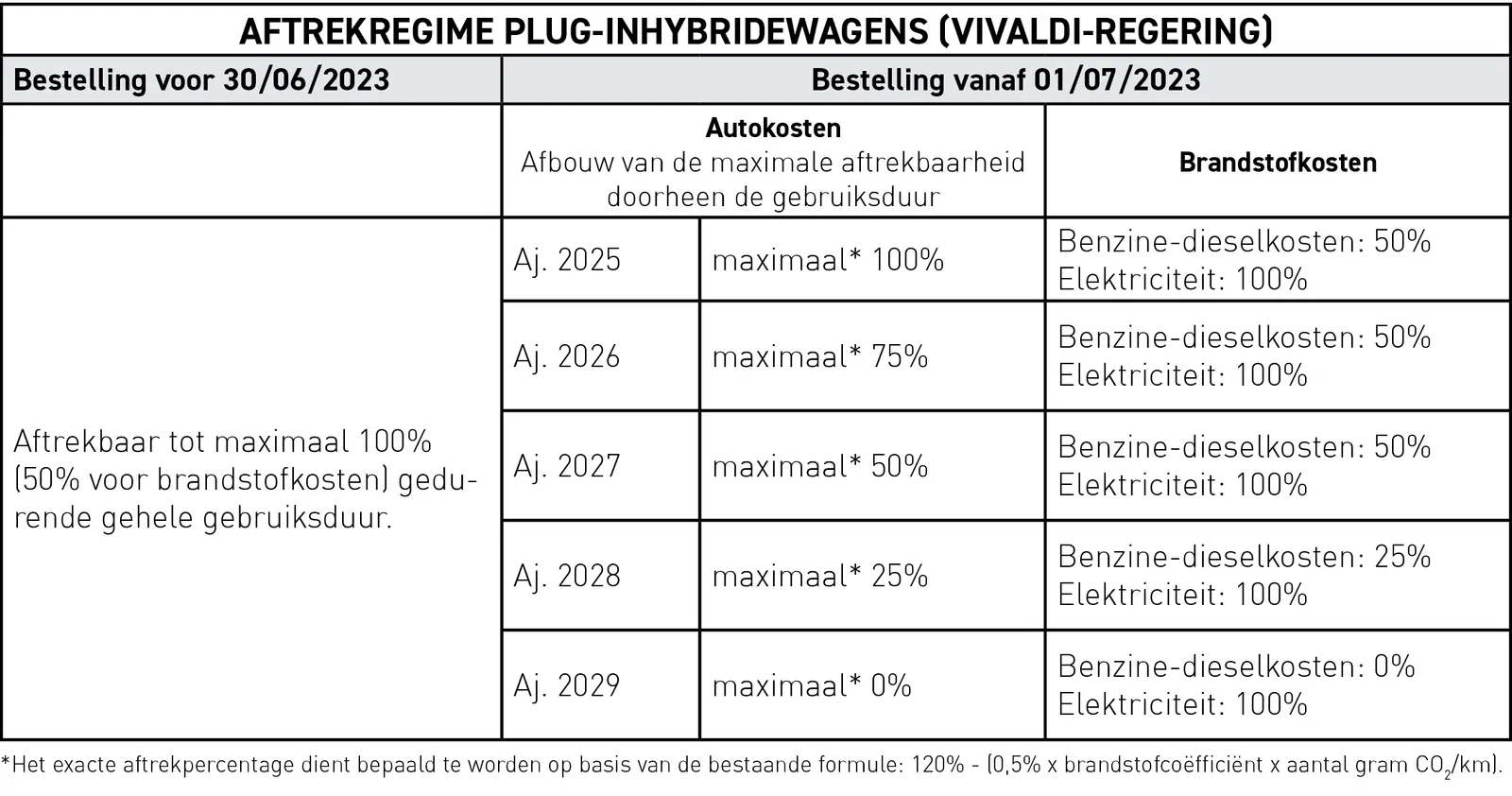
The tax deductibility of car expenses was calculated using the following formula:
120%: (0.5% x fuel coefficient
x number of grams of CO2/km).
The fuel coefficients are: diesel: 1.00, petrol (including hybrid): 0.95 and natural gas: 0.90.
Because of their low CO2 emissions, the costs of plug-in hybrids were often up to 100% tax-deductible. However, this only applied to hybrid cars with a battery capacity of at least 0.5 kWh per 100 kg of vehicle weight and emissions of less than 50 grams of CO2 per kilometre.
Cars that did not meet these requirements were also known as ‘false hybrids’ and were treated for tax purposes in the same way as cars with only an internal combustion engine, resulting in a lower deduction.
Revised emissions threshold leads to a sharp rise in CO2 emissions
Which standard?
On 1 January 2025, the new European ‘EURO-6e-bis’ emissions standard for fuel-powered cars came into force. It introduces significantly stricter CO2 tests and results in higher measured CO2 emissions.
In practice, all new car models homologated from 1 January 2025 will already fall under this new standard. From 1 January 2026, the CO2 emissions of existing car models will also have to be recalculated under the new standard.
Which cars?
This applies only to new cars with a production date from 1 January 2025 (new models) or 1 January 2026 (existing models). Cars produced before these dates are not affected. For most manufacturers, the EURO-6e-bis standard will apply to cars from model year 2026 onwards. When ordering a new car, it is advisable to ask the manufacturer which standard it will fall under.
What impact?
The change to the method used to measure plug-in hybrid emissions is expected to lead to a sharp rise in these cars’ official CO2 emissions. Emissions are expected to double for most plug-in hybrids.
The new tax rules under Arizona
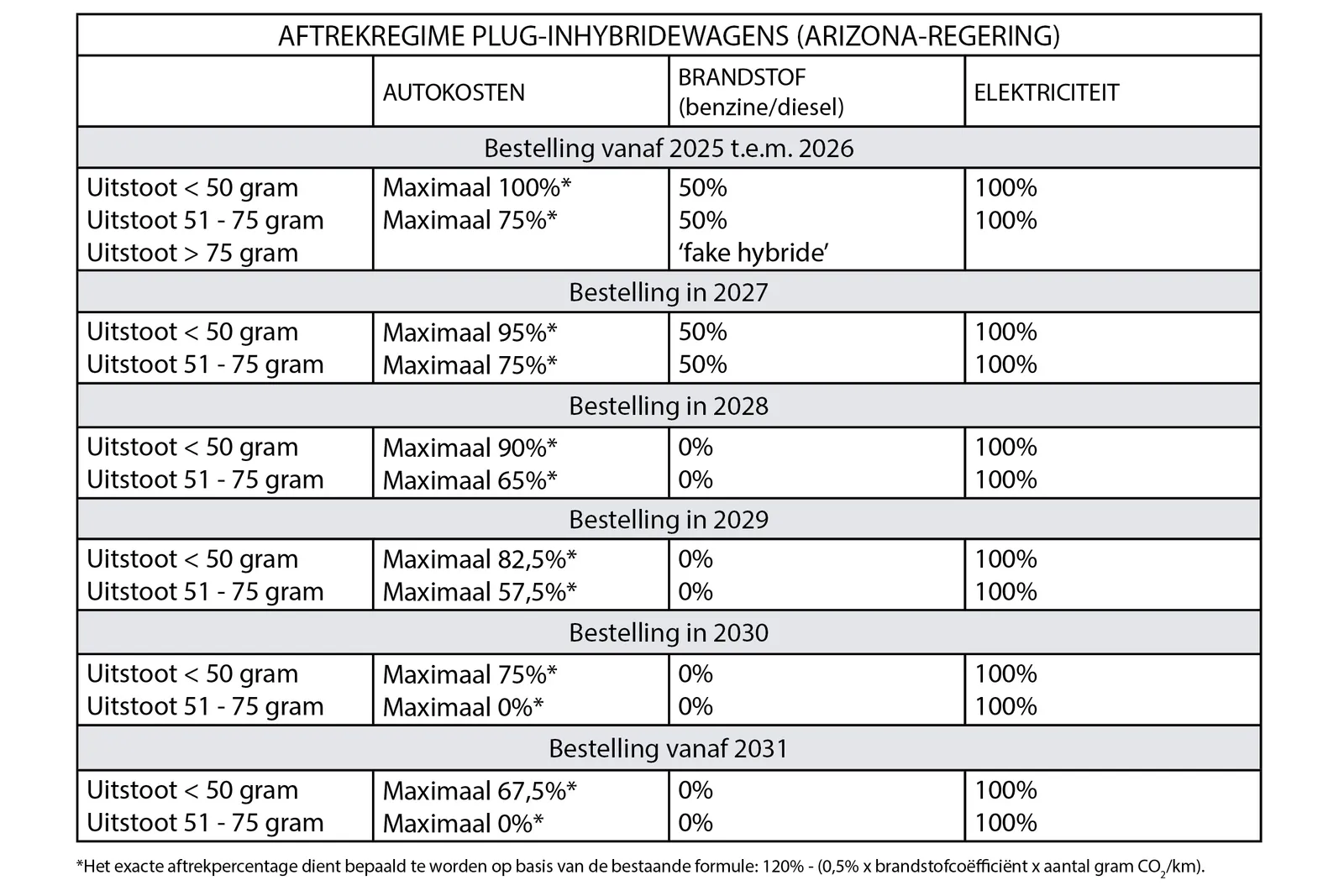
As a result of the revised emissions standard, many cars would exceed the 50-gram CO2 threshold in future and qualify as so-called ‘false hybrids’. However, in the Easter Agreement, the federal government raised the CO2 threshold from 50 g to 75 g per kilometre for cars covered by the new EURO-6e-bis standard.
The phase-out of tax deductibility for plug-in hybrid cars was also postponed. In addition, the deduction percentage is once again ‘locked in’ in the year the car is ordered, meaning there is no longer a ‘phase-out scenario’ over the car’s period of use.
Under these new rules, plug-in hybrid cars can once again benefit from a tax regime that is almost identical to that for fully electric cars, depending on their CO2 emissions.
What does this mean for you as a business owner?
The revival of plug-in hybrid cars offers new opportunities to benefit from tax advantages. Want to know what this means for your fleet? Discuss it with your accountant or tax adviser and find out how you can shift up a gear on the tax front too.
Een zakelijke vraag aan Titeca? Get in touch
Companies in this story

Keep following this
Get an email when a new story is published. No account needed.
- ThemeFinancial and legal decisions
- SubjectHR, finance & IT
- CompanyTiteca