




VRT journalist Ivan De Vadder takes stock
Text Christina Van GeelImage VRT, Damon De Backer, An Clapdorp/Ertsberg
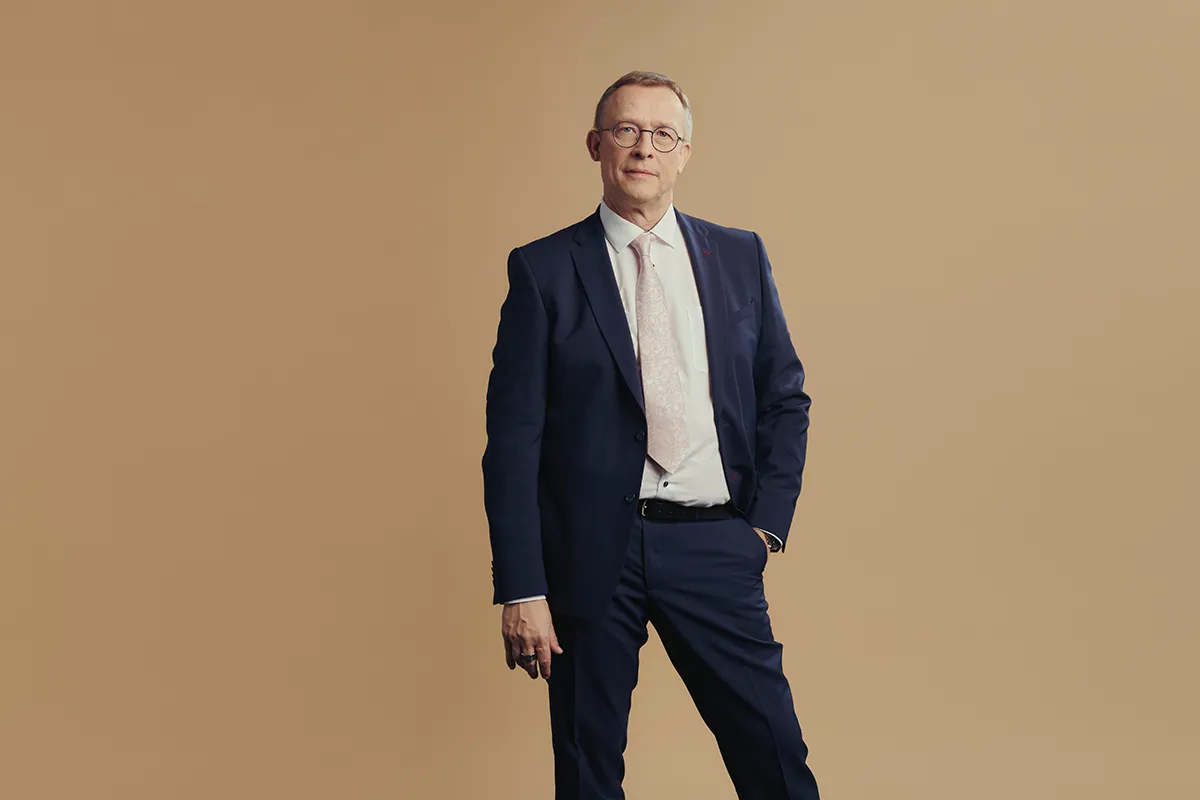
“I’m critical, but at the same time very forgiving of politicians”
Ivan De Vadder has been a familiar voice in political journalism for many years. With sharp analysis, probing questions and plenty of flair, he makes Belgium’s political landscape accessible to a broad audience. In this candid conversation, we take stock of a career spent between power and the media. The story of an impatient journalist learning to appreciate things taking their time. A critic who is hard on himself, politicians and angry citizens alike. A conversation about the profession and conviction, but also about love and the fear of loss.
What did you dream of becoming as a child?
As a child, I never wanted to be a firefighter or a pilot. I wanted to be a journalist: to be in the front row, observing and analysing. To put what was happening into words and make current affairs accessible in that way. That is why I went on to study Germanic languages in the early 1980s. There was no dedicated journalism course back then. By studying linguistics, I wanted to sharpen the tool a journalist needs above all: language.
I’m now deeply involved in politics. It’s a passion. So I can understand why people sometimes ask whether I’d rather be on the other side. When something matters so much to you, don’t you want to have more say in it? To be completely honest… the thought does sometimes cross my mind: couldn’t I, as a politician, handle this differently and better? But it’s a different profession. This is how I try to be part of the action without falling into the trap of joining in. I’ve also written around ten critical books about politics. That’s my role, and that’s how I play the game.
Has the role of journalists changed?
Yes. Journalists used to be gatekeepers who decided what news you got to hear. That traditional role is now contested and under attack from two sides. On one side, politicians discovered social media around fifteen years ago. It’s a tool that lets them reach their audiences directly and without limits, with no pesky gatekeeper selecting what gets through. On the other side, the public also attacks the gatekeeper, accusing them of viewing things through an ideological lens. I think that’s unjustified. We still strive to be impartial. Of course, we are critical, that’s our duty. And if, as a media consumer, you’re used to hearing only your own views confirmed in the echo chamber of social media, a journalist’s critical voice can be irritating.
Who do you admire, and why?
I’m not going to name one particular politician. But the people at the top, party leaders, ministers, the prime minister and members of parliament too, are not in it to line their pockets. They’re not fools. They genuinely have a vision for society. Of course, some do a better job than others and work harder. But believe me, most politicians are trying to improve society from within their own ideology. And each party’s ideology is fundamentally different. Someone from N-VA has a different utopia in mind from someone in PVDA, to name two extremes. But in every party, there are people who make me think: “The way they’re trying to put that ideology into practice, hats off to them.”
Politicians are a favourite target for a lot of people. But I’m very forgiving of them, because I feel that most people who enter politics do so with complete dedication. What you do see is that people who spend years operating within a system sometimes adopt and defend its flaws. I think holding multiple jobs is disastrous. I don’t understand how you can be mayor and party leader at the same time. Those are two very demanding jobs, and you can’t combine them. That’s a very unpopular view in the Wetstraat. But I won’t be persuaded otherwise. As an MP, your job is not to lobby for your municipality, but to serve the whole community, at Flemish or federal level.
I also think you should be allowed to serve a maximum of two terms. In my ideal world, you’d serve two terms as a municipal councillor, then perhaps two terms as mayor and two terms as an MP.
Politics is too often seen as a lifelong career. Things work differently in the Netherlands. I see former politicians moving into business, trade unions and the cultural sector… It’s not so straightforward here. So perhaps I’d urge business leaders to think about this and be more open to the idea. Like business leaders, politicians have a utopia. They have in common a drive to make a difference to society.
What important lesson in life did you learn from your parents?
My parents always gave me the freedom to choose what I wanted, but they also expected me to do it as well as I could. I soon realised that the harder you work, the more opportunities and freedom of choice you have. At school, I made sure I got good marks. That meant I could study what I wanted. In my first year of Germanic languages, I really let my hair down. I had a very tough resit exam, which I eventually passed. If I hadn’t worked incredibly hard at the last minute, I would have had less freedom of choice. My father had died shortly before, and I had a grant. Would I have been able to repeat a year? Would I have had to choose a different subject? And would that have meant taking a roundabout route to fulfil my dream of becoming a journalist?
I’ve never regretted any of the big choices I’ve made in life. Because I’ve always been free to pursue what I really wanted. And because I’ve always worked hard to make that possible. I love what I do. I’m allowed to work until I’m sixty-seven, if my health permits. What more could you ask for? That’s a big part of being happy in life.
What do you consider to be your greatest talent?
I can quickly connect the dots, analyse what they mean and form an opinion. That’s often helped me in my work. But that talent doesn’t come entirely naturally. It also takes hard work. For example, when my radio colleagues ask me to provide analysis of current affairs on air in fifteen minutes, I don’t have time to read up on the subject first. To make sure I can think that quickly, I read at least ten newspapers every day, and listen to and watch radio and television analysis, preferably on different channels. To use a buzzword, I’m permanently ‘on’. I’m always preparing and analysing. The downside is that I have to schedule holidays very deliberately. I’ve learnt to do that. Otherwise, you can’t keep up that pace.
What is your greatest weakness?
I struggle with slowness. Slow thinking, slow communication, slow action. I realise that a slow process can produce just as good, or even better, results than a fast one. But I find it difficult. Inefficiency annoys me, and that also leads to slowness. At the same time, I realise that getting annoyed is itself a huge waste of time, and therefore a weakness. If, for example, I get annoyed by traffic jams, I have no time at that moment to do other, more useful things. I know all this rationally, but it’s hard to change your nature.
What makes you angry?
I sometimes get angry with angry citizens. When people say they’re angry at ‘politics’, I always throw the question back at them. Because what do you see at elections? People often vote for familiar faces who don’t necessarily know much about politics. Meanwhile, young, capable people find it much harder to get elected. So some of those angry voters haven’t really thought carefully about how they vote. They shouldn’t complain about politicians afterwards.
As a citizen, you also have a responsibility in a democracy. I think we don’t emphasise that nearly enough. I find it shocking when people don’t vote. Afterwards, they have no right to an opinion, let alone to complain. And believe me, every vote counts. There are plenty of known cases where a handful of votes have made the difference. I think it’s disastrous to take yourself out of the game as a voter.
And far worse than the angry voter is the indifferent voter, the one who disengages. Anger is an emotion, and you can still do something with it. Once you’re indifferent, there’s no hope left. Not voting, that indifference towards democracy, is a very harsh verdict on politics.
Are you afraid of anything?
Yes, of being left alone. The thought that my wife might die before me is a very frightening one. It sounds harsh to say, but I’d rather die first. I’m afraid of loneliness at a fundamental level. Of losing that sense of being two as one. My wife and I are two souls in one body. If you lose one of them, you’re no longer whole. You lose a huge part of your richness and diversity. That’s the other side of love, that feeling of perfect harmony and merging. I’m incredibly lucky to have found that love. It’s something I can always fall back on. The love I feel for my wife, and the love she gives me, allow me to live life to the full.
What does our world need, in your view? And what do you do to help?
Our society would benefit if everyone made a little more effort. Communicate better, and above all, listen better. Because the importance of listening is often forgotten in communication, just as it is in our profession. The best interviewer is the one who listens, not the one who asks the sharpest questions. Making a greater effort as a society is about shifting small stones. The great revolutions have always been evolutions, and evolutions happen when small stones are moved regularly, not when huge dams are built. Those dams are broken through anyway, and then the water flows back.
Question about this story? Ask your question
Keep following this
Get an email when a new story is published. No account needed.
- SubjectGeneral







