




Vlaams onderzoek helps accelerate the electrification of shipping
Text Björn CrulImage Damen Shipyards, Flanders Make
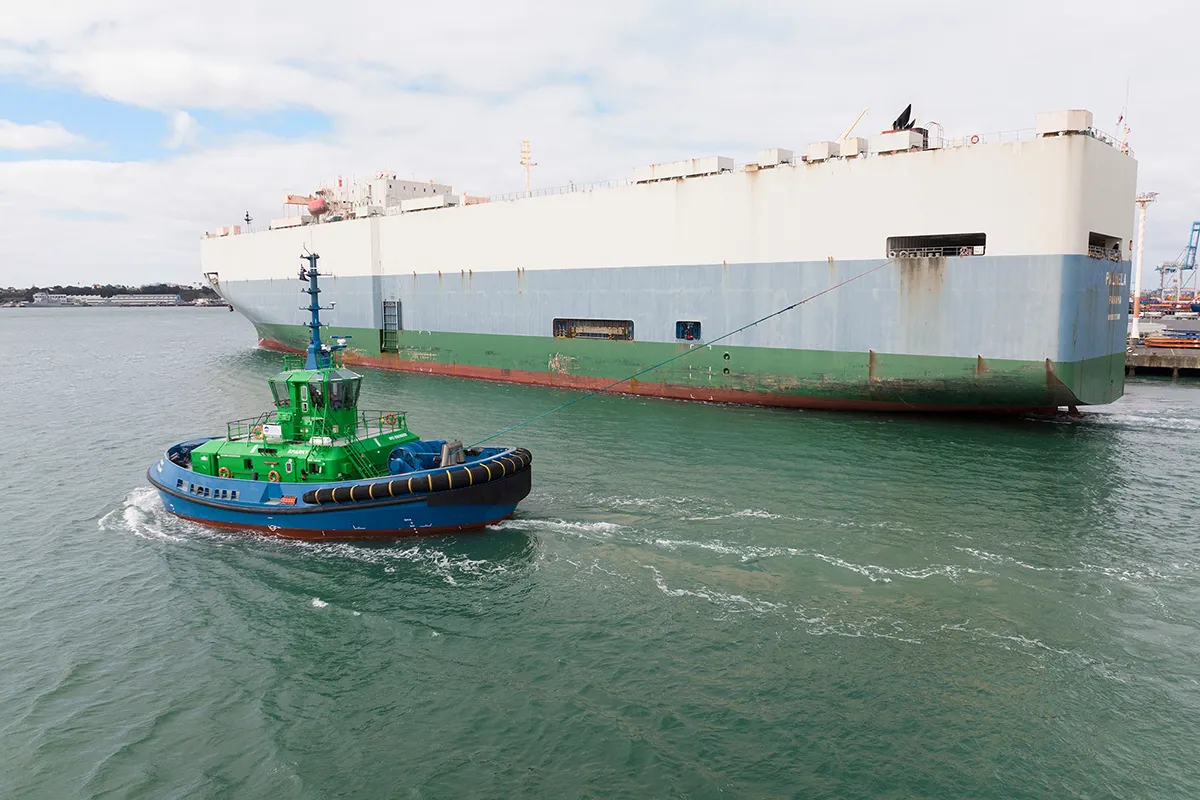
Shipping is one of the most important transport modes for the global economy. But international shipping remains a major polluter, producing 1 billion tonnes of greenhouse gases each year. Electrification is one possible solution. Damen Shipyards, one of Europe’s largest shipbuilders, is a pioneer in this field. It is developing electric vessels with support from industrial research centre Flanders Make.
Turning a tanker around is said to be a slow process. The same is true of the maritime sector’s transition to sustainability. As recently as this year, Donald Trump blocked the International Maritime Organization’s climate agreement. The IMO had planned to introduce a CO2 levy from 2028 to accelerate the international shipping industry’s shift to fuels with a lower environmental impact. The ultimate goal is to achieve zero emissions by 2050.
An agreement on self-regulation may now be at least a year away. But the momentum behind greening the maritime sector cannot be stopped. Nearly 100-year-old Dutch group Damen Shipyards builds dozens of types of vessels, from fishing boats, pontoons and tugboats to specialised vessels for dredging and defence. The company aims to lead the way, Peter Rampen, principal research engineer at Damen Shipyards, told the latest Flanders Make Symposium in Brussels.
“We have made the strategic choice to electrify. This has a profound impact on our designs, our production chain and even the way we think about a ship’s service life. This is disruptive: once you integrate a multi-megawatt battery into a ship’s hull, everything changes, from safety and cooling to space requirements and certification. And we remain responsible for the technology that must be able to propel our ships for many years.”
Diversity and complexity
Electric propulsion is therefore a highly complex challenge. A tugboat needs high peak power during manoeuvres, while a patrol vessel requires a steady power output over long periods. This diversity is the biggest obstacle. Peter Rampen: “Unlike the automotive industry, we can’t develop a standard battery that fits every application. We build small series, each with its own requirements. That means we have to find the right battery technology and configuration all over again each time.”
Nevertheless, major progress has been made in recent years. Damen has built both hybrid and fully electric tugboats, a technological feat. “Many people thought electric propulsion would never provide enough power for heavy-duty towing. Yet we have managed it: a compact vessel about 25 metres long, equipped with 2 × 2 megawatts of propulsion power and 3 megawatt-hours of battery capacity. These tugboats are not only sustainable, but also high-performing.”
Hybrid technology has potential
Port of Antwerp-Bruges is also showing keen interest. The port is testing both hybrid and fully electric vessels. Flanders Make, the research centre for industrial innovation, played an important role in developing the hybrid technology. Stephan Schlimpert: “Damen came to us with specific questions: how can we make tugboat batteries more compact, lighter and more efficient? How can we reuse the same modules in batteries for different types of vessels? This led us to a hybrid system combining two types of battery: one capable of delivering extremely high power for short, forceful movements, and a second designed for high energy density and long-duration operations.”
Rampen says it is a robust solution with many benefits. “Our calculations show that this hybrid configuration makes the battery significantly smaller. That means a lighter boat, lower costs and a much smaller environmental footprint during production. In some cases, we can save up to half on materials and emissions. This offers considerable potential for wider deployment.”
Charging infrastructure needed
A crucial factor is charging infrastructure, or having sufficient shore power available. “At the moment, we use a charging solution tailored to a single vessel type. So here too, the question is how to find charging systems that can be used for several applications,” says Peter Rampen. “We need to reach a situation like that for electric cars, where one plug or one standard is enough. Europe is working on new standards for heavy-duty applications, but progress is too slow.”
To further accelerate the transition to sustainability, Damen Shipyards is looking at broader partnerships. “Our market is too small for us to develop all the technology ourselves. We need partners: research centres such as Flanders Make, ports, battery manufacturers and even other shipbuilders. That is the only way electrification can truly take off,” Peter Rampen concludes.
Question about this story? Ask your question
Keep following this
Get an email when a new story is published. No account needed.
- ThemeTransforming business mobility
- SubjectGeneral







