




“The more Belgian beer there is on the shelf, the better we sell abroad”
Text Björn CrulImage Tjorven
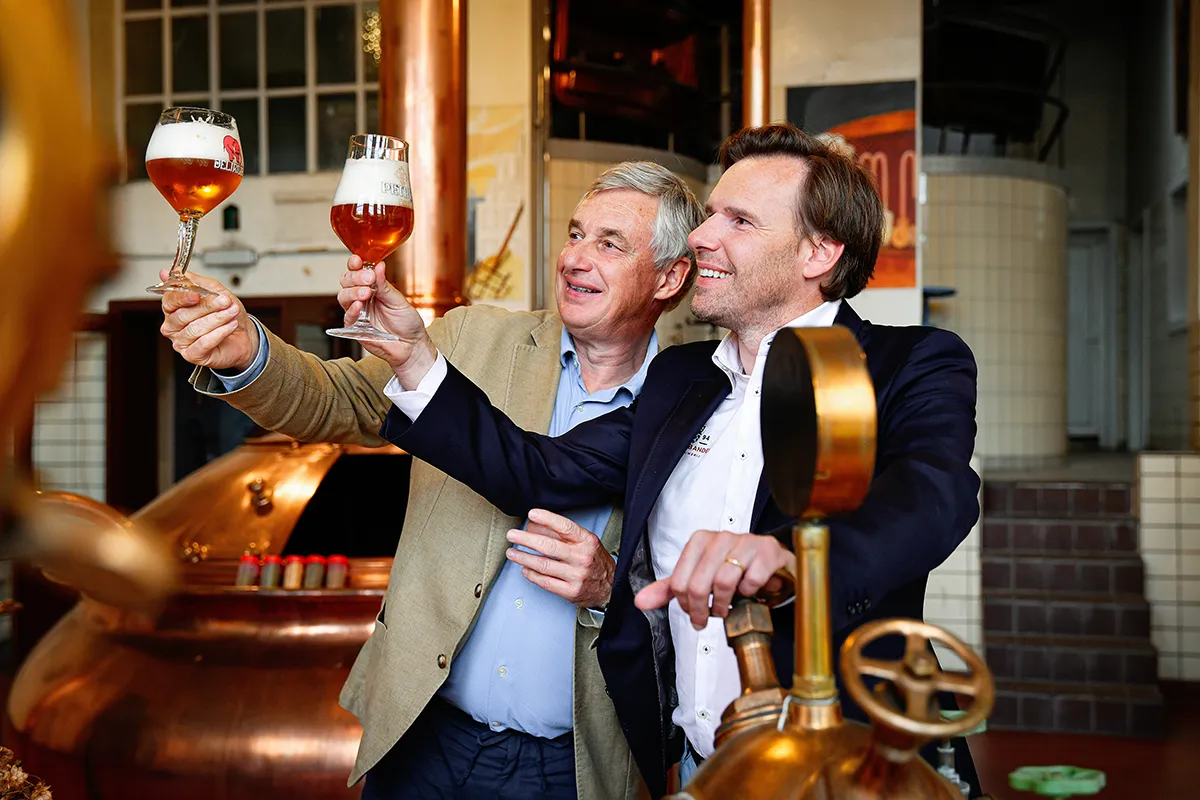
Bert De Brabandere and Alain De Laet on the camaraderie among family brewers
Belgian beers enjoy a strong reputation worldwide. This is due in part to the efforts made by medium-sized, family-owned breweries over recent decades to export and promote their beers. But in recent years, the sector has faced challenging times: falling beer consumption in Belgium, increased competition and the potential impact of US import tariffs are putting profitability under pressure. With the crucial summer season just around the corner, we take stock with Bert De Brabandere (Brouwerij De Brabandere) and Alain De Laet (Brouwerij Huyghe).
Can you give us an initial assessment of 2025? Is it shaping up to be a good year for your breweries?
Bert De Brabandere: We are optimistic. Beer sales remain highly weather-dependent. Last year, we had an exceptionally rainy spring, whereas this spring has been much sunnier, and that is immediately reflected in the figures. We are seeing growth in Belgium, France and the Netherlands. We brew around 40 beers, but Bavik Super Pils remains our main product, alongside the Petrus and Kwaremont brands. Of the 200,000 hectolitres we will produce this year, half is destined for export. That is relative, though: because of our geographical location, northern France is part of our home market, but sales there are included in our export figures.
Alain De Laet: Our brewery has around 45 beers, accounting for some 280,000 hectolitres this year. Delirium is our flagship, alongside Carolus and Averbode. We have seen phenomenal growth since 2010. Covid hit us hard, but was followed by a record year in 2022, when everyone was once again free to go out without restrictions. We could not match that in 2023 or 2024. This year is looking better again so far. But since 80% of our beer production goes abroad, I remain cautious.
Exports have been a growth market for Belgian speciality beers for years. How badly could you be hit by the trade war Donald Trump has unleashed?
Bert De Brabandere: We are experiencing exceptional times for our exports. Let us not forget that, since the war in Ukraine and the European sanctions against Russia, we have lost that important market altogether. Higher import tariffs in the US will inevitably affect sales. To give an example: a 10% duty at the border can quickly translate into a 20% price increase for the end customer, once importers’, distributors’ and retailers’ margins are factored in. We can offset some of that through negotiation. A higher tariff would make that very difficult. We have taken precautions, though, by shipping much more product to America in recent weeks. Above all, we must hope that a reasonable deal is reached by 9 July …
Alain De Laet: Absolutely. If Donald Trump makes good on his threat and imposes a 50% tariff, you would really have to brew locally to remain profitable. But that is technically almost impossible, because Americans have no experience with beers that undergo secondary fermentation in the bottle. And I honestly cannot see us setting up a local brewery. Immediately after Trump’s first announcement, we shipped a 3 to 4-month supply of beer to the US in containers. We are brewing our Christmas beer at the moment. That too has to be shipped now, whereas normally we would not send it until August. Fortunately, we have had our own import company in the United States since 2018, which means we can act very quickly. We set our own strategy, so we do not have to enter into lengthy negotiations with an importer.
The Belgian beer market has been in structural decline. Can breweries turn the tide?
Alain De Laet: The Belgian beer market has been declining for twenty years in a row, by a few per cent each year. Of course, we are coming off a golden era. In the early 1980s, there were still around 100 larger breweries in our country. That was followed by a period of takeovers and consolidation. Those that remained independent enjoyed a golden period of growth. Our turnover, for example, rose from 1.5 million euros in 1985 to 45 million today. Exports were a key driver of this, first in Europe and later further afield. Since Covid, we have seen growth stall in those overseas markets too. Local breweries are emerging, and price wars are commonplace. Our Belgian beers are still the best, but they are now among the most expensive too. To maintain sufficient sales volumes, we therefore have to give up some margin.
Bert De Brabandere: I am chairman of the Belgian Family Brewers, an association representing 21 family breweries that are over 50 years old. It is important that we continue to think long term, which is typical of family businesses in our sector. We keep investing, even against the tide. I see further growth opportunities for De Brabandere in the Netherlands and France. For exports further afield, the key is to keep building strong brands. It is less easy than it used to be, but it can be done.
Alain De Laet: The camaraderie among family brewers is our strength. We therefore take the initiative to promote our Belgian beers together during trade missions and at events such as Belgian Beer Week USA and Belgian Beer Week China. The more Belgian beer there is on the shelves of foreign shops, the better we all sell.
Bert De Brabandere: Consumers in countries such as France, the US and South Korea are very interested in Belgian beer. We need to showcase our quality, tradition and stories together. That strengthens the image of Belgian beer and gives us the opportunity to build our own brands afterwards. In the years ahead, we need to be more proactive about this and make more of our family-business DNA when talking to, for example, an importer in Italy, a café owner in the Netherlands or a distributor in France. Long-term relationships and continuity will be more important than ever, for them too.
Craft beers and microbreweries are thriving. How are you innovating your ranges further?
Bert De Brabandere: One of the areas the sector is focusing on is low-alcohol and alcohol-free beer. That will certainly be part of our future, though not for every beer. If you love Orval, you mainly want ‘the real stuff’. We are working on beers with more flavour and lower alcohol content. We also have our own microbrewery, which allows us to experiment.
Alain De Laet: We owe it to our customers to keep improving and coming up with new ideas. Our company now has five microbreweries and also has a whiskey distillery in its portfolio. It is not just about new flavours or new products, either. We also need to keep our marketing up to date and find new ways to connect with consumers. That requires a highly flexible organisation that keeps its finger on the pulse of what is happening.
The summer holidays are just around the corner. How important is a good summer for the hospitality sector and your beers?
Alain De Laet: We would prefer an average summer, with a bit of sunshine and temperatures of 20 to 22 degrees. That is ideal for sitting outside. If it gets too hot, people choose soft drinks rather than beer. For the hospitality sector, we mainly hope that things remain viable, because Minister Vandenbroucke’s plans to curb alcohol could have far-reaching consequences. Of course, we need to tackle binge drinking and alcohol addiction. As a sector, we have already taken steps in that regard. But surely we are not going to stigmatise people who drink socially?
Bert De Brabandere: The hospitality sector has suffered, and many businesses have closed since Covid. Yet our diverse hospitality landscape is a treasure that has no equal in other countries. We do not want people to be patronised. Let people enjoy a pint in a pub, a cigarette on a terrace, a networking reception among businesspeople … How many friendships begin during football’s third half or over a post-ride chat among recreational cyclists? The hospitality sector supports the social fabric of our society. Let us not forget that.
Question about this story? Ask your question
Keep following this
Get an email when a new story is published. No account needed.
- SubjectGeneral







