




The lawyer as a spatial planning analyst
Text Ruben Volckaert & Liese VanasscheImage Bricks Advocaten
“Government, provide a clear and predictable framework for spatial development”
Flanders is a region with limited space where a rapidly growing population, an expanding economy and increasingly stringent environmental requirements converge. Add a political landscape in which policies are constantly shifting, changes of power follow one another and symbolic cases are championed, and the result is clear: spatial planning can be particularly complex here.
Every spatial planning decision has direct and often far-reaching consequences for current and future property owners, property professionals and entrepreneurs. A policy change can restrict the development potential of a plot, put pressure on the value of a property or completely derail future plans.
A wave of non-conforming use
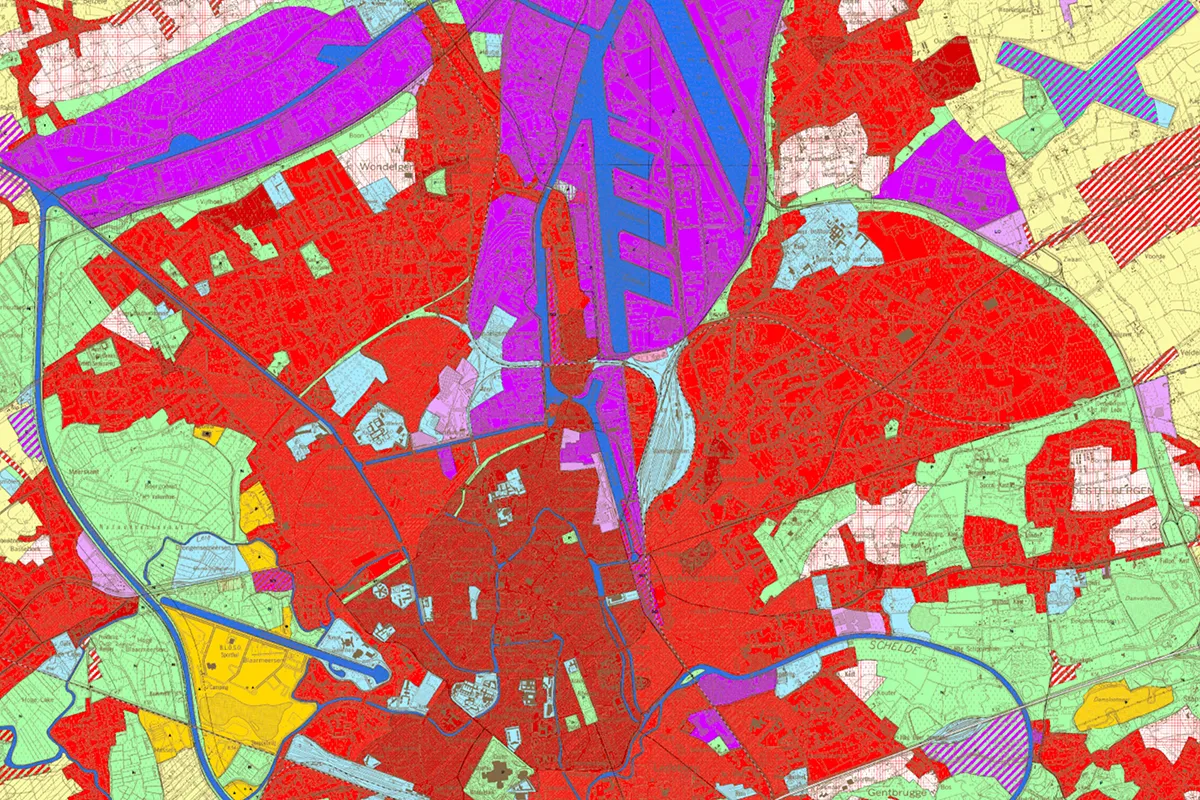
One example is the so-called non-conforming use of land and buildings. In Flanders, countless structures are already, or will soon be, classed as non-conforming. A structure is non-conforming when, under the applicable plan, it lies in a zone with the ‘wrong’ designation. Examples include a home in a recreational area, a business in a buffer zone or a shop in an agricultural area. This is a concept rooted in the past, but it can also result from changes in policy.
In the past, there was hardly any spatial planning policy. Buildings were placed at random, leading to nuisance and disruption: factories in the middle of residential areas, houses in the countryside, recreational facilities in nature areas, and so on.
The government sought to bring order with the introduction of the Town Planning Act (1962) and, later, regional plans. However, these regional plans triggered a wave of non-conforming use: existing areas were suddenly given a designation that did not match their actual use.
Basic rights for non-conforming structures
It was impossible for the legislature to redraw all designations retrospectively without infringing existing property rights. The Flemish Spatial Planning Code therefore provides basic rights for non-conforming structures, including homes and other buildings. These rights offer some protection, but are subject to strict conditions. Those who fail to apply the rules correctly or seek insufficient information may face unpleasant surprises. Decisions made in the past can have a major impact on the future.
Long-term planning is not the only reason for action. Social developments also compel the government to act. Non-conforming homes in agricultural areas, in particular, have been a hot topic in environmental law for years, creating considerable legal uncertainty. On average, 1.3% of agricultural businesses in Flanders cease trading each year. Their homes are then bought by private individuals who simply want to live there, a process also known as “farmettisation”.
The residential conversion of agricultural businesses poses a difficult balancing act for the Flemish Government. On the one hand, there are calls to preserve agricultural land as much as possible for farming. On the other, there is reluctance to see the value of old farmhouses fall. Farmers who cease trading may consequently be unable to realise the value of their farm at the end of their career.
But this is not the shift with the greatest spatial impact. According to its own figures, the Flemish Government intends to make changes affecting no less than 68,900 hectares. For example, it plans to sacrifice 31,500 hectares of agricultural land in favour of, among other things, 19,500 hectares of nature area. At the same time, it is tackling known non-conforming situations by keeping a very close eye on the application of the basic rights for non-conforming structures.
Major legal uncertainty
For now, however, concrete measures and legislative initiatives have yet to materialise. The result is considerable legal uncertainty, with a direct impact on property values. Predictability and stable policy are essential for making plans and investment decisions. Until matters are clarified, many will have to wait and see what is possible on the ground and how this will affect value, use and investment.
We therefore extend a warm invitation to the government: provide a clear and predictable regulatory framework that guarantees a long-term vision. This will make it possible to take well-considered decisions and invest sustainably in the future, which is crucial for entrepreneurs and everyone subject to the law.
Until then, the parties concerned must think and plan for themselves. In this complex landscape, a lawyer can certainly play an important role, alongside the architect. Lawyers have long done more than provide purely legal advice: increasingly, they act as spatial planning analysts, considering the complete picture.
This means the case is no longer addressed only once problems arise, but is managed proactively. The project is screened in advance, and risks and bottlenecks are identified so that the right exit strategy can be determined together with the other parties involved, within a complex and stringent regulatory framework. Fortunately, plenty of government agencies are still willing to think things through with them.
Een zakelijke vraag aan Bricks Advocaten? Get in touch
Companies in this story

Keep following this
Get an email when a new story is published. No account needed.
- ThemeFinancial and legal decisions
- SubjectGeneral
- CompanyBricks Advocaten







