




“The domestic market remains vital to exporting Belgian expertise”
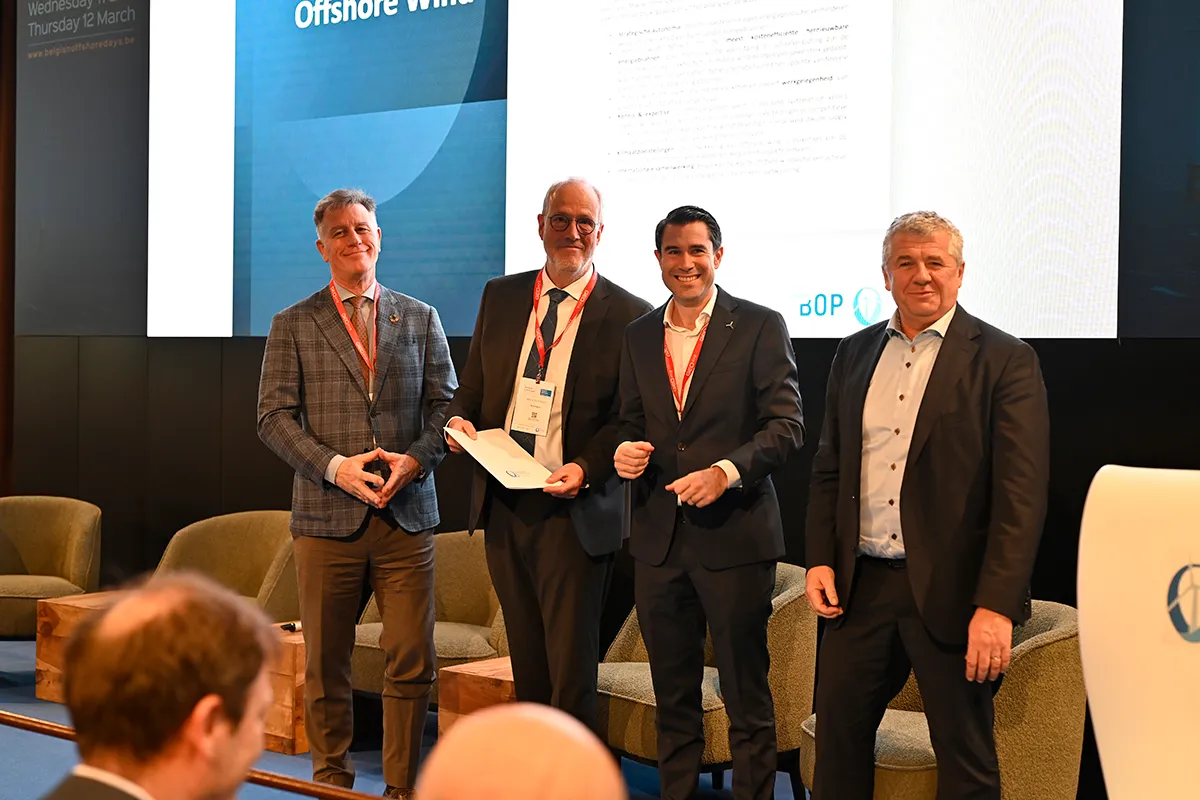
At Belgian Offshore Days, taking place today and tomorrow in Ostend, six leading organisations from Belgium’s offshore wind sector are calling on the federal government to urgently move ahead with the first tender in the Princess Elisabeth Zone (PEZ 1). This joint call echoes the recently launched Offshore Industry Statement and makes one point clear: the longer a decision on the tender is delayed, the greater the social and economic cost, including for consumers. “It’s five minutes to midnight, and it’s time to act,” says Ward Gommeren of the Belgian Offshore Cluster.
Belgium currently has 2,262 MW of offshore wind capacity, accounting for around 10% of national electricity consumption. Offshore wind has thus become a strategic asset for the country. It not only strengthens our energy independence, but is also one of the most cost-effective renewable energy sources. It also supports a strong industrial value chain and high-quality jobs. Yet this strategic sector is under pressure, in part because the federal government has yet to decide on the new offshore wind tender (PEZ1).
A stable and ambitious framework is essential
In a joint statement, Agoria, Blauwe Cluster, Belgian Offshore Cluster, Belgian Offshore Platform and Sirris/OWI-LAB are sounding the alarm. “We need consistent policy that enables further investment and safeguards the future of offshore wind in Belgium. Offshore wind is not just a climate solution, but also a driver of economic growth, technological innovation and international standing,” says Ward Gommeren of the Belgian Offshore Cluster.
The six signatory organisations stress that investment certainty is essential. “The lack of tenders creates uncertainty in the market and risks leaving companies without contracts between 2026 and 2028. This has direct consequences for jobs, innovation and our international standing.”
At the recent North Sea Summit in Hamburg, nine North Sea countries set out their ambitions: 300 GW of offshore wind by 2050, up to €1,000 billion in investment and tens of thousands of additional jobs. “Every country made it clear that the North Sea is no longer seen merely as an energy source, but as a strategic lever for energy security, industrial resilience and geopolitical autonomy. Prime Minister Bart De Wever himself stressed that closer cooperation is crucial to safeguarding our security of supply and competitiveness.”
Accelerating project delivery
However, according to the sector organisations, more is needed to strengthen the offshore industry. With the Offshore Industry Statement, they spell out what needs to be done. “First and foremost, it is essential to speed up the delivery of a number of projects. At the same time, it is crucial to level the playing field and give European developers equal opportunities in international markets. This means developing a targeted internationalisation strategy and maintaining the policy vision for the blue economy,” says Piet Opstaele, CEO of Blauwe Cluster. It is also important to continue actively supporting innovation and research if the sector is to remain at the forefront. “Create incentives, address the wage cost handicap and simplify administrative procedures.”
Without supportive policies, the cost to the country could also rise sharply. This is borne out by a recent analysis by the PATHS2050 Coalition, led by VITO/Energyville. “If a decision on the Princess Elisabeth Zone is delayed further, resulting in a 5-year delay, offshore wind generation in 2030 will be 12 TWh lower. This would come with an increase in CO2 emissions of around 2 million tonnes and a temporary 4 to 7% rise in electricity bills, or around €400 million,” explains Opstaele. In that case, the country would also become more dependent once again on gas-fired power stations and electricity imports. “Delays mean higher bills, and pressure on electricity prices will last longer. This is a scenario we cannot afford, economically or socially.”
Scaling up Belgian expertise
At Belgian Offshore Days, the six parties are urging policymakers to take all the signals from the sector seriously. “The event is the ideal platform for shaping the sector’s future. The energy transition calls for clear choices and a long-term vision. Those who hesitate today will pay more tomorrow. And those who move faster today are investing in affordable energy, strategic autonomy and a strong Belgian industry,” says Ward Gommeren.
The event itself focuses on internationalisation. “In recent years, we have continued to develop our ecosystem. The question is no longer whether Belgian expertise is relevant internationally, but how it can be scaled up and leveraged worldwide. Markets in Europe, Asia, North America and South America see us as the go-to partners with the right expertise.”
Question about this story? Ask your question
Keep following this
Get an email when a new story is published. No account needed.
- SubjectGeneral







