




“Our teams’ drive to innovate is our greatest asset”
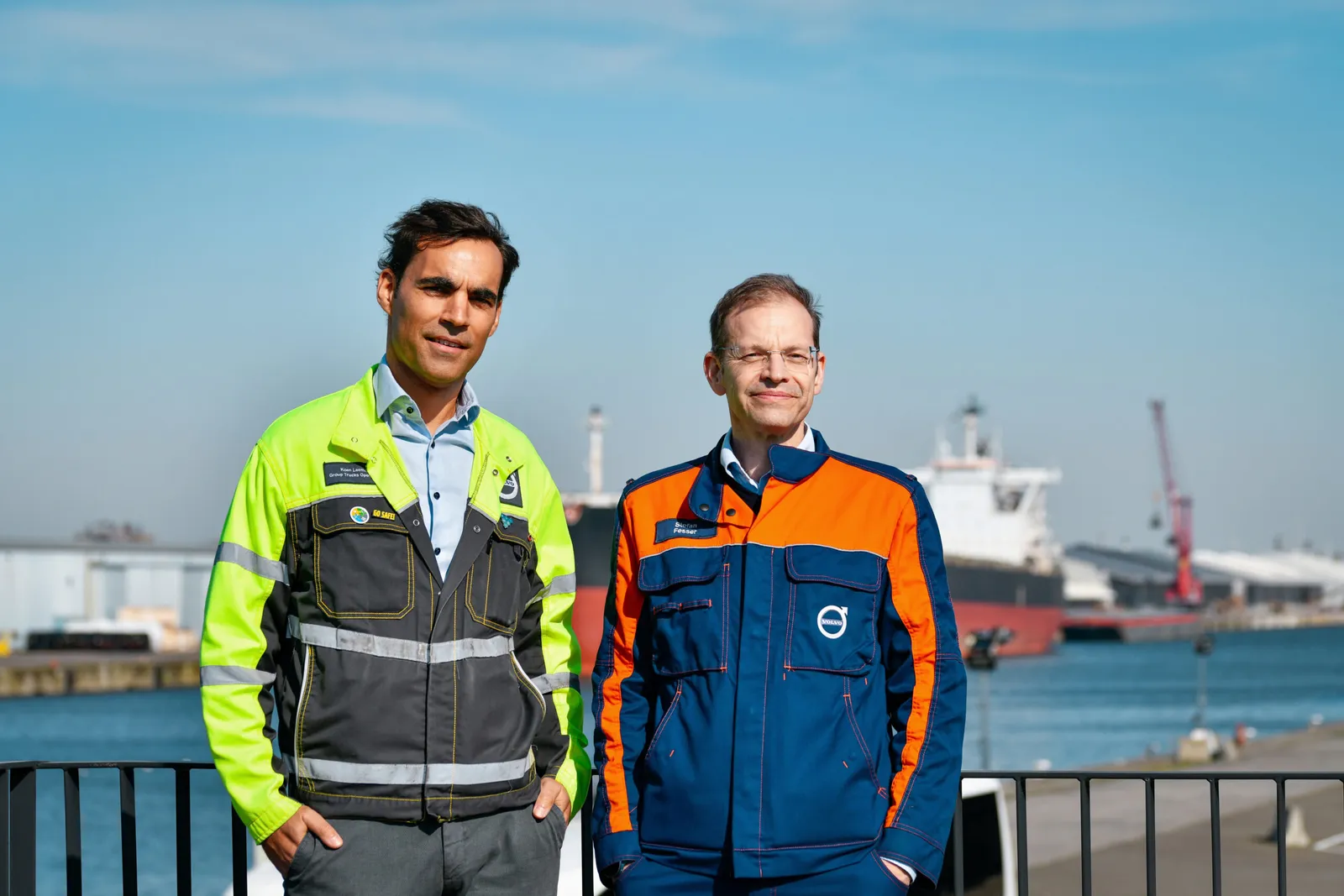
In the 1990s, our country could still boast a significant presence of car manufacturers. But following the closure of Renault Vilvoorde (1997), Opel Antwerpen (2010), Ford Genk (2014) and Audi Vorst (2025), Volvo Car in Ghent is the only car manufacturer left in the country. A little further on, in North Sea Port, we also find the world’s largest Volvo Trucks factory. Although the two companies now have different owners, their success stories have striking parallels, as emerges from a joint interview with Stefan Fesser, CEO of Volvo Car Gent, and Koen Leemans, CEO of the Volvo Trucks factory in Ghent.
Your companies have a long history in Ghent. Volvo Cars opened its factory here in 1965, while Volvo Trucks has been present in the port area since 1975. Why is North Sea Port such an attractive location?
Koen Leemans: Having a factory in a port area with excellent multimodal connections is a major asset for us. We have a very good freight connection with our head office in Göteborg, which is essential. We produce 40,000 heavy-duty trucks here each year, making this the largest production site in our group worldwide. Many partners are also close by, including DFDS and Katoennatie. Together with the port authority, we are working on a so-called green corridor to make the transport of our finished products to Southern and Eastern Europe greener. North Sea Port’s ambitions on carbon neutrality are a perfect match for our own objectives.
Stefan Fesser: The central location in Europe is crucial for us too. As a company, we want to manufacture in the markets where we operate and source as many components as possible from the region. To that end, we have built a large supplier ecosystem around this factory. The Port of Ghent is highly accessible for our inbound and outbound logistics. For example, we have our own rail terminal on site and also use a short-sea connection with the port of Antwerpen. Together with North Sea Port and the port community, we are working to ensure that we have the right infrastructure and sufficient renewable energy in the future, so we can further decarbonise our logistics.
Manufacturing in Belgium is facing difficulties. How have your factories managed to weather the successive crises of recent years?
Stefan Fesser: A combination of factors has helped us to establish strong roots here. For me, it is mainly down to the flexibility and agility of all our teams. We have shown that we can deliver new assignments flawlessly and efficiently. We were the first site to start battery assembly, for example. We were the first Volvo factory in Europe to build a fully electric car, and we are now producing our third EV model. Last year, we produced more than 186,000 cars with a workforce of 6,500. Our ability to lead the way in innovation, rather than rest on our laurels, makes our factory and the entire supplier ecosystem more resilient. Ultimately, that is what protects jobs. We are still hiring too.
Koen Leemans: Much the same applies to us. For decades, we have had a culture that encourages us to deliver strong results. The Volvo Trucks factory in Ghent stands for premium quality at an acceptable cost, delivered on time. We are also a first mover in innovation. Our factory has been carbon-neutral since 2007, for example. We have configured our production lines to handle all models, whether diesel or fully electric. Because we perform so well, the group continues to invest, and we continue to recruit to grow our team of more than 4,000 employees.
Multinational groups often see an internal battle to secure new models or orders. What do you have to do to remain competitive?
Stefan Fesser: We know that energy and labour costs in Belgium put us at a disadvantage. That is why we are focusing heavily on reducing our energy demand, for example with new electric ovens in the paint shop. Generating our own renewable energy also makes us less dependent on price shocks in the energy market. We have both wind turbines and solar panels, and a heat network with Stora Enso, through which we recover its surplus heat. There is only one solution to labour costs: keep innovating and automating to improve efficiency. We introduced the new EV model EX30, with more than 500 new robots on our lines, in half the time planned. Those achievements do not go unnoticed by our Chinese owner, Geely.
Koen Leemans: We produce all Volvo Trucks heavy-duty models for the European market, so there has never been competition for a new model. We are, however, seeing the transition to electric trucks taking longer than expected. For the first time, the group is therefore asking whether electric heavy-duty vehicles should still be produced at every site. That requires major investment. In the long term, it is of course a no-brainer, but for now we are keeping a very close eye on market developments. The geopolitical situation, including import tariffs, also plays a part. But there is no doubt that we are keeping a close watch on our efficiency, both in terms of energy and labour costs.
What is the biggest challenge facing your site at the moment?
Stefan Fesser: Everyone knows that the automotive sector is highly competitive. Fortunately, we can draw on a long history and Volvo’s strong reputation for design and safety. The challenge now is to be more flexible and faster than the rest of the market. We are investing in a green and digital transformation. Fortunately, we have government support. The European Commission’s Clean Industrial Deal is a good first step, but the key will be translating it into measures that deliver practical benefits for us.
Koen Leemans: I completely agree with Stefan. We too know that new competitors are on the way and will challenge us. We need to reinvent our production, because incremental innovation alone will not be enough. To remain relevant in the future, we also need to upskill and reskill the available talent. The further transformation of our operations will require hundreds of new people with the right attitude and a willingness to continue developing their skills.
Both Volvo Car Gent and Volvo Trucks are currently recruiting, including for dozens of technical roles. Are you competitors in the labour market?
Koen Leemans: Yes, in that respect we are competitors. The labour market remains tight, and we are both looking for technical talent, people with digital skills and employees willing to work shifts. At the same time, I believe that jobseekers often encountering the Volvo brand can work to our advantage, because both companies are growing and have a positive image. The difficult situation does not mean we will simply open the door to everyone, though: we stick to our recruitment process. People still have to fit the organisation’s DNA, and that is precisely our strength. In total, we employ people from around 70 different nationalities.
Stefan Fesser: Our strength lies in offering people a highly skilled workplace at companies that invest heavily in innovation. That is good news for the port community and for Ghent as a whole: Volvo Car and Volvo Trucks have long-term ambitions and offer sustainable employment. The challenge is to keep explaining that industry is about people, and to show the next generations entering the labour market how attractive our jobs are. Our recruitment policy puts culture and values first. That is one reason why our workforce includes more than 70 nationalities. We are proud that people from a second or even third generation of the same family are now also working in our factory.
Finally, what does the future hold? What plans do you have for your factories?
Stefan Fesser: The launch of the Volvo EX30, which is built on the same line as the existing models, is a major milestone for Volvo Car Gent. It represents a total investment of 220 million euros. It proves that our factory is ready for the future. We have the potential to increase production to 250,000 cars a year in the coming years. But we will need to remain agile, because technology is still evolving at breakneck speed and market developments are less predictable than ever.
Koen Leemans: The future looks positive. I see plenty of opportunities in our masterplan through to 2028, and we still have land available to expand our site. The challenge, however, is to keep strengthening our competitiveness. Taking the factory to an even higher level with the whole team is a challenge, but it can also be hugely rewarding if you are open to it. The time we are living through now is one of the most interesting periods of my career.
A business enquiry for Volvo Car Belux? Get in touch
Companies in this story
Keep following this
Get an email when a new story is published. No account needed.
- SubjectGeneral
- CompanyVolvo Car Belux







