




“Our scale and firepower are essential to being futureproof”
Text Björn CrulImage Mathieu Van de Sompel
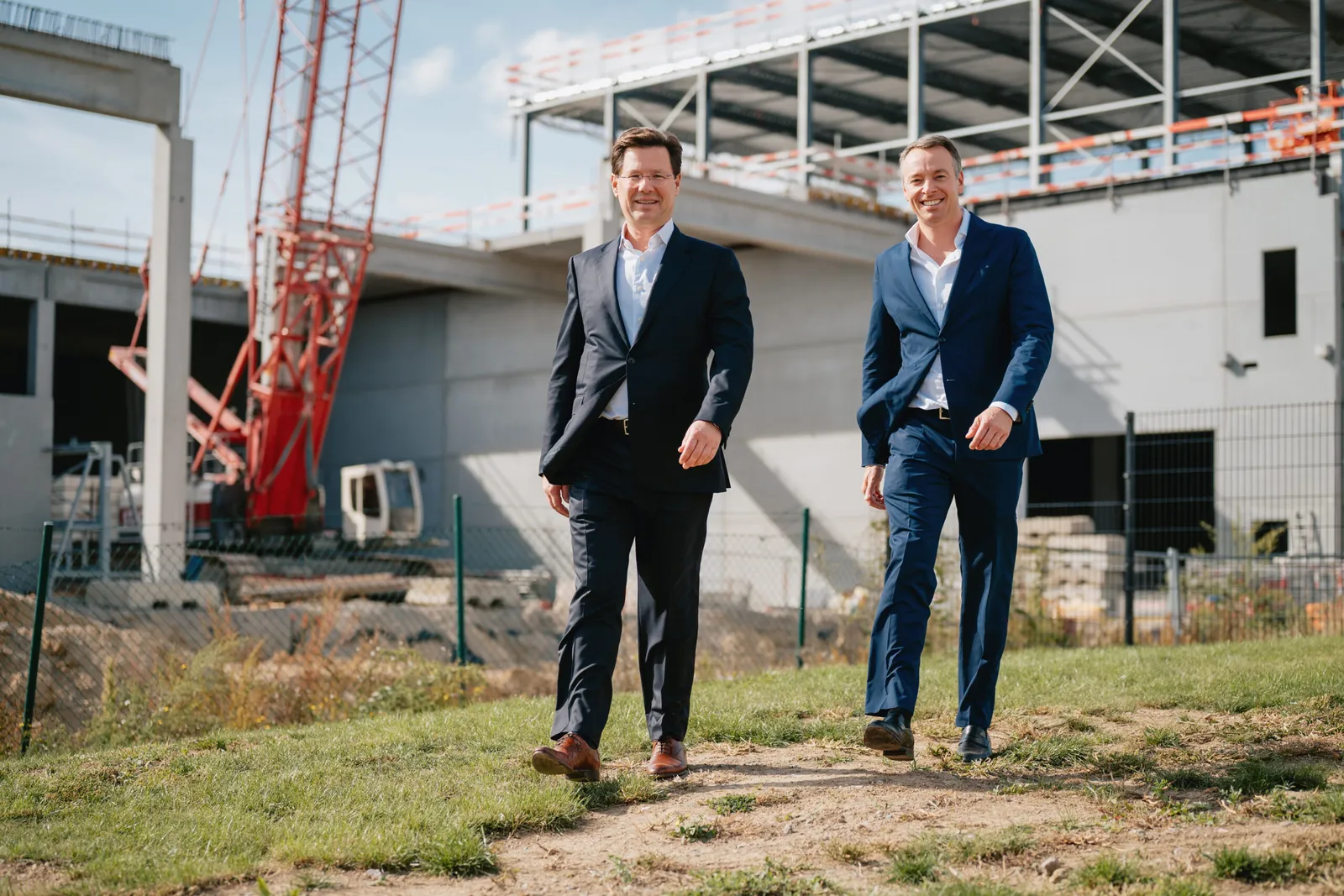
Dominique Valcke (Stadsbader Group) & Pieterjan Desmet (Decospan)
The Flemish economy is powered by family businesses built up and handed down over generations. Yet growing a business and maintaining its success from one generation to the next is often less straightforward than it seems. Construction company Stadsbader Group, now led by third-generation family member Dominique Valcke (53), and veneer specialist Decospan, represented by third-generation CEO Pieterjan Desmet (43), show that it can be done. We brought them together for a joint interview about running family businesses in challenging times. The two entrepreneurs know each other well: Stadsbader is currently working on Project Nexus, the ambitious expansion of Decospan’s site in Menen.
You are both building on family businesses with a long history: Stadsbader is 80 years old, while Decospan is almost 50. Does that history shape the way you run your businesses?
Dominique Valcke: We are proud of what we have built and determined to develop it further. Continuing the business is the starting point for everything we do. That applies to my stepfather, from whom I bought the company, to me as CEO and owner, and to my son. The most important thing I was taught is always to think long term. That is part of our DNA, as is our passion for our work.
To preserve that DNA, we invest heavily in communication within the family and in our governance. We have an advisory board and a continuity board. They include several external members who will ensure that the strategy, vision and values remain intact if anything happens to me. This is how we aim to prevent the company from becoming unmanageable if the CEO is no longer there.
Pieterjan Desmet: Our family governance is also well established. We have a family council representing the adult generations, where we discuss business matters. That is where we set out the family’s vision, which is then implemented by the board of directors and management, while giving them the necessary freedom to bring fresh ideas to the business. This allows us to preserve the company while also giving us room to prepare it for the future.
For example, we decided to keep Decospan in family ownership. That decision is only revisited every 10 years. This schedule also means we regularly update the shareholders’ agreement and family charter. The company comes first, not the individual. That is why we also have ‘Project Terminus’, which prepares for the eventuality that the CEO is no longer there. Many parties are involved in the process: the family, management and the board of directors. Everyone knows what to expect in that situation.
A long-term vision is a typical strength of family businesses. But in a more complex and volatile world, can you still look and plan far enough ahead?
Dominique Valcke: It still comes down to mapping out the opportunities and threats, and working out how to respond to them. The big difference is that, as a family group, we are prepared to invest in long-term projects, even if they do not pay off immediately. That is why we have deliberately opted for vertical integration and diversification. This strengthens our firepower and creates new opportunities for our people. We also invest in sustainable projects that may not deliver the highest returns straight away, but do lay the foundations for long-term value creation. By consistently investing in assets, knowledge-sharing and expertise, while staying true to our DNA, we are convinced that sustainable growth will follow, even in a more complex economic and geopolitical context.
Pieterjan Desmet: We know exactly where we want to go strategically. We have planted our flag. Geopolitical headwinds are making the journey stormy, so we have to adjust our course more often, but the destination itself is unchanged. Take the investment in new production facilities for Decospan in Menen. You should not assess it on the basis of a short-term return on investment. We are making this investment to win the war in 10 years’ time. But to do that, you obviously need both your shareholders and your banks on board. We have a clear view on this: if we want to expand the group further, what are we comfortable with as a family business? What level of risk are we prepared to take? That framework and a clear risk profile should stop ambitious people from taking reckless leaps.
Both your groups have grown organically and through acquisitions. Stadsbader now has 2,300 employees, while Decospan has around 1,250. How important is scale in your businesses?
Pieterjan Desmet: Scale is everything for us: either you are a small, specialised player with turnover of up to 10 million and good profitability, or you need to generate a few hundred million euros to fund the major investments required for Industry 5.0. That is the whole philosophy behind our new factory: extensive automation, technology-driven, with an SAP S/4Hana / Digital Manufacturing package as its backbone, enabling us to deliver even more added value to our customers. Without scale, that would be impossible. As a consolidator in the European veneer industry, we have completed a number of acquisitions. But we have always taken a professional approach and based our valuations on objective criteria. As CEO, I also need to feel that a company is a cultural fit with our organisation. If it does not feel right intuitively, we do not do it.
Dominique Valcke: We need scale to deliver more than 250 projects a year and take on major projects such as Oosterweel or works on the Brussels ring road. But we deliberately continue to carry out smaller projects too, to keep the organisation agile. It is about investing in firepower and expertise. Take our most recent acquisition this spring, DCA Infra. It was a company in difficulty, but its core was sound: it had people with expertise and very good customer relationships. Those are foundations you can build on while tackling the problems. It also strengthened our presence in the Kempen and Limburg.
Decision-making speed is often cited as an advantage of family-run businesses over international corporates. Does that speed hold up as a company grows into a larger group? How do you safeguard it?
Dominique Valcke: It is a privilege to grow alongside the family business. But you have to let your own insights evolve and adapt your management style. If you can trust the people around you, such as your executive team, you can maintain your speed. We now have 21 sites, where we are determined to preserve an entrepreneurial spirit. That is one reason why we want as few shared services as possible. HR, for example, is organised on a decentralised basis, so that each entity is responsible for it itself. They can, of course, call on central support where needed.
Pieterjan Desmet: When I joined the company, we had 300 people. I worked my way through every level, which means I can still understand any file very quickly, even though I have now been involved for 20 years. Decision-making speed now depends on the quality of the people we have hired. I expanded my core team early on, and now I know I can trust the information they give me. That was a major mental step: placing 100% trust in information you have not gathered yourself.
You both invest in Belgium and provide significant employment here. If you could name one measure politicians should take during the current legislative term to support your companies’ ambitions and growth, what would it be?
Pieterjan Desmet: Fewer rules. We have become a society that starts from a position of distrust. I am calling for a cultural shift, with fewer rules and more trust. Every rule requires monitoring, and therefore civil servants to check compliance. Today, 35% of the working population is employed in the private sector and 65% by the government, either as civil servants or indirectly in organisations subsidised by the government. That is not sustainable. Let us do the right things for our people and our environment, not out of fear of being checked, but because we trust that we are looking after the future of society.
Dominique Valcke: I agree: politicians, run the public sector like a business. In our family business, we have to be lean, constantly reinvent ourselves and act with respect, guided by our values. Tackling inefficiency is part of our daily work. The public sector is undoubtedly complex, but that is precisely why it is important for our political leaders to keep striving for an efficient, high-performing government.
Question about this story? Ask your question
Keep following this
Get an email when a new story is published. No account needed.
- SubjectGeneral







