




Lokeren Mayor Filip Antheunis speaks
“Like businesses, the city also has to watch its budget”
Filip Antheunis (Open Vld) has been mayor of Lokeren for almost 22 years. On 1 January 2001, he succeeded his father Georges, who had also served as mayor for 23 years. Located centrally between Ghent and Antwerp, Lokeren has seen strong economic growth in recent decades. The city develops the business parks in its area itself, but is gradually running out of space for new sites. In the coming years, its development as ‘Chocolate Valley’ and a merger with Moerbeke-Waas could provide further momentum.
Mayor, what factors underpin your city’s economic success?
Filip Antheunis: To start with, the fact that we have come through a deep trough. In the last century, we were a true textile city, but when that sector declined because of fierce competition from low-wage countries, Lokeren went through difficult times. In the 1970s and 1980s, our unemployment rate was at times the highest in Flanders. The city council then decided to buy land, develop it as a business park and provide roads and infrastructure. This gave the local economy a major boost.
As a result, today we have a dynamic business community, with a strong mix ranging from local self-employed people to typically Flemish SMEs and large multinationals, active in a wide variety of sectors. The fact that so many have chosen to set up in Lokeren is, of course, down to our location on the E17 between Ghent and Antwerp. Brussels is not that far away either.
So the city plays a very active role in deciding where businesses locate. How do you approach this?
Filip Antheunis: To this day, we develop our own industrial zones. This gives the city considerable influence. One factor we always take into account is, of course, employment. When planning business zones, the impact on the surrounding area is also an important consideration.
Our basic philosophy is that we want to support self-employed people and businesses in establishing their operations. We want to help make things happen rather than look for reasons to stop them, because those are all too easy to find. That is why we set up a dynamic economic affairs department where entrepreneurs can turn with all their questions. We also maintain very good contacts with the various business networks to keep abreast of what is happening.
Which sectors or activities do you see potential in for the future?
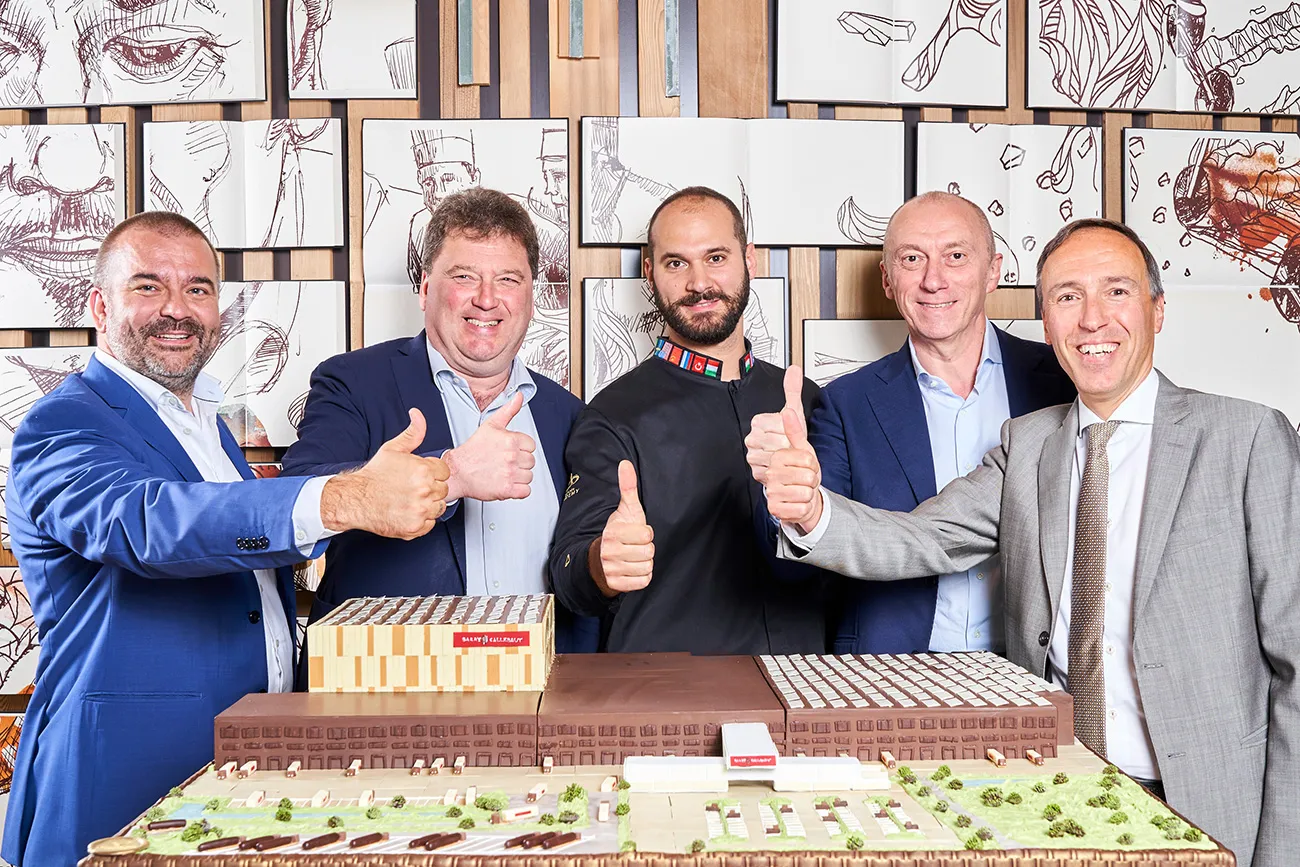
Filip Antheunis: We have a striking number of chocolate-processing businesses and specialist logistics companies serving the sector. We see potential there, including in tourism. That is why I like to talk about ‘Chocolate Valley’. We will really develop this in the coming years. Barry Callebaut, which has only recently started using a large new warehouse in Lokeren, will serve as a showcase.
Does the city still have business space available?
Filip Antheunis: Well, demand for space remains high. Over the past two years, we put 46 hectares of business land up for sale at the new E17/4 industrial park, where Barry Callebaut also has a site. At prices of between 150 and 175 euros per square metre, the area was not cheap.
Even so, all the plots were reserved within three months. Covid caused a few prospective buyers to drop out, but the park is now fully occupied. Two-thirds of the businesses are from Lokeren and are relocating, including SMEs currently based in residential areas. The development of this zone has therefore been a great success.
The downside, however, is that there is currently not much industrial land left for new businesses. We no longer have a land reserve, and we are constrained by access and mobility: there is no scope for further expansion along the E17 unless we create a new
entrance and exit. I do not think that is realistic, though. We are now in contact with the province and neighbouring municipalities to discuss our future strategy.
Lokeren also has a role as a shopping town. Have you seen an impact from the Covid pandemic and the subsequent energy crisis?
Filip Antheunis: The pandemic hit our businesses hard, but until before the summer I had the impression that our businesses and entrepreneurs had bounced back. Lokeren is a pleasant provincial town, but conditions are challenging for independent retailers today. They are also facing increased online sales. Still, my impression is that Covid had little impact on vacant premises. A few shops have closed, but I have also seen new initiatives.
Now we are dealing with an energy crisis, as well as inflation and wage indexation. This could certainly pose a problem for the local economy. We are hearing from businesses that they are struggling. The city also has to watch its budget, of course. When drawing up our budgets, we are seeing the same effects as businesses.
What impact could this have on your city?
Filip Antheunis: Through our multi-year plan, the City of Lokeren has built up a reserve of 14 million euros. The initial projections we are now making, which take account of rising wages, inflation and energy costs, indicate that we would use up that entire reserve by the end of the current council term. That means an additional 14 million euros in expenditure in around 2.5 years. We will therefore postpone a number of planned projects.
Our policy statement was very ambitious, and we now need to spread things out over a longer period. All in all, though, I do not see that as a problem. We are a healthy city with 42,500 inhabitants. We are also on track to merge with Moerbeke-Waas. From 2025, we will grow into a city of around 50,000 inhabitants, covering a large area between the E17 and the Antwerp-Knokke Expressway.
Many businesses are also struggling to find talent. How can the city help them?
Filip Antheunis: The city wants to act as a catalyst between education and business. We connect students from our secondary and technical schools with businesses. We also organise an annual jobs fair to showcase vacancies at local businesses. At the last edition, there were no fewer than 720! I also spend an afternoon talking to parents and children in the sixth year of primary school, who have to choose what to do next, to encourage them to consider technical occupations and the technical schools in our area.
Finally, which projects do you still want to deliver during this council term?
Filip Antheunis: We need to improve mobility around our business parks. If you want to encourage employees to travel more by bike, the necessary facilities need to be in place. As we develop the sites ourselves, we will invest even more in cycle paths and cycle links. That is already the case at the newest industrial park, and we also want to introduce additional measures at the older ones. There is also too little public transport serving businesses. I hope we can agree a new De Lijn timetable in the so-called transport region in the short term, so that the industrial parks are better served.
Question about this story? Ask your question
Keep following this
Get an email when a new story is published. No account needed.
- SubjectGeneral







