




Leiedal seeks solutions to dwindling business space
Text Björn CrulImage Leiedal
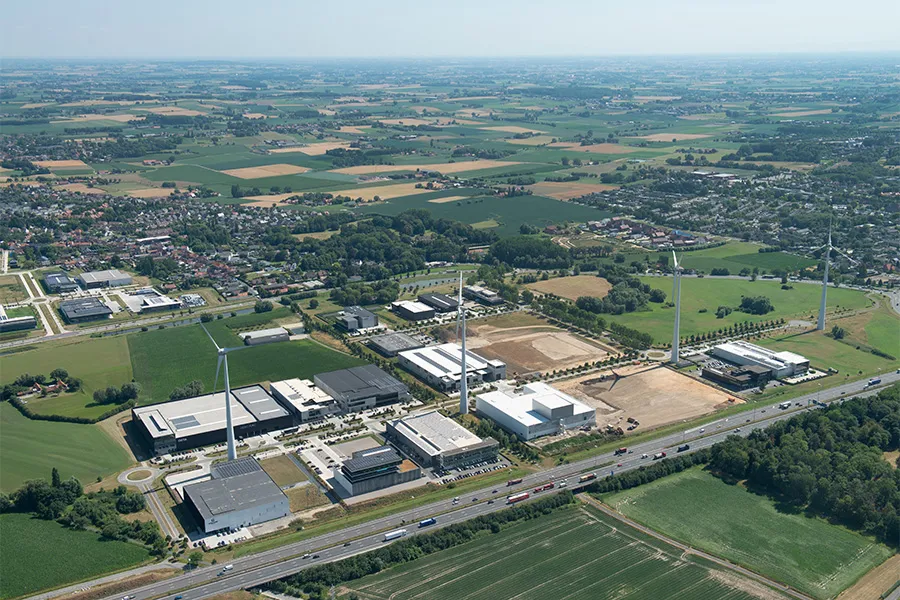
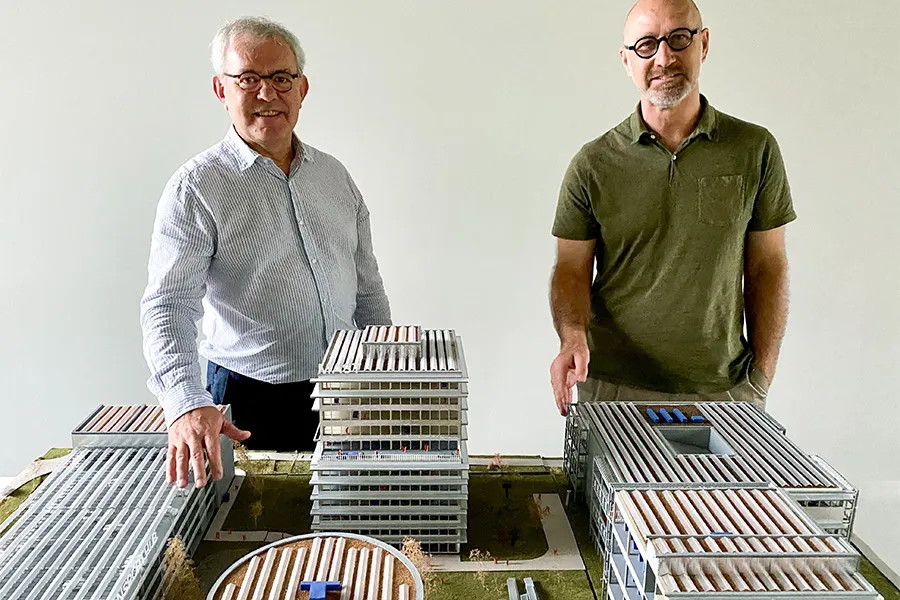
More and more municipalities in Flanders are facing a shortage of space for businesses. The Kortrijk region is no exception. Intermunicipal organisation Leiedal, which is responsible for regional development in South West Flanders, among other things, is looking for long-term solutions. “This will involve redevelopment, building upwards and stacking, circularity, but just as importantly, involving businesses in the development process as early as possible,” say managing director Filip Vanhaverbeke and Steven Vanassche, public project development coordinator.
Over the past few months, dark clouds have gathered over the Flemish economy. Various factors, including inflation and a shortage of available talent, are weighing on growth and undermining business confidence. Filip Vanhaverbeke: “In our region, we are seeing that the economy has certainly not ground to a halt. Demand for business space has stagnated, though. But businesses are still looking for space, both SME workshops and larger sites on regional business parks. Demand will not fall in the longer term either.”
The enquiries Leiedal receives are becoming more varied. Businesses, for example, are placing greater emphasis on sustainability or are looking not for a standalone plot, but rather an environment in which they can grow and co-create. At the same time, available space is becoming scarcer. Steven Vanassche: “For larger businesses, we still have two major greenfield sites: the expansion of Evolis in Harelbeke and the new Blauwpoort site in Waregem will provide a net total of just over 40 hectares. We need to build more efficiently when developing these sites. That means not only building higher, but also stacking more functions and taking account of circular construction.”
With support from Europe, the intermunicipal organisation commissioned a study into the potential and design parameters for business buildings where multiple companies can group their activities, with production stacked across floors and shared facilities. “For the De Stapel pilot project, we brought together a multidisciplinary team. We needed not only designers and engineers, but also lawyers and financial experts. A stacked building is a complex structure, after all, involving different physical and technical considerations, as well as a need for different agreements between partners or within a co-owners’ association. This study now serves as a blueprint for exploring potential European funding to implement the concept.”
Purple freckles
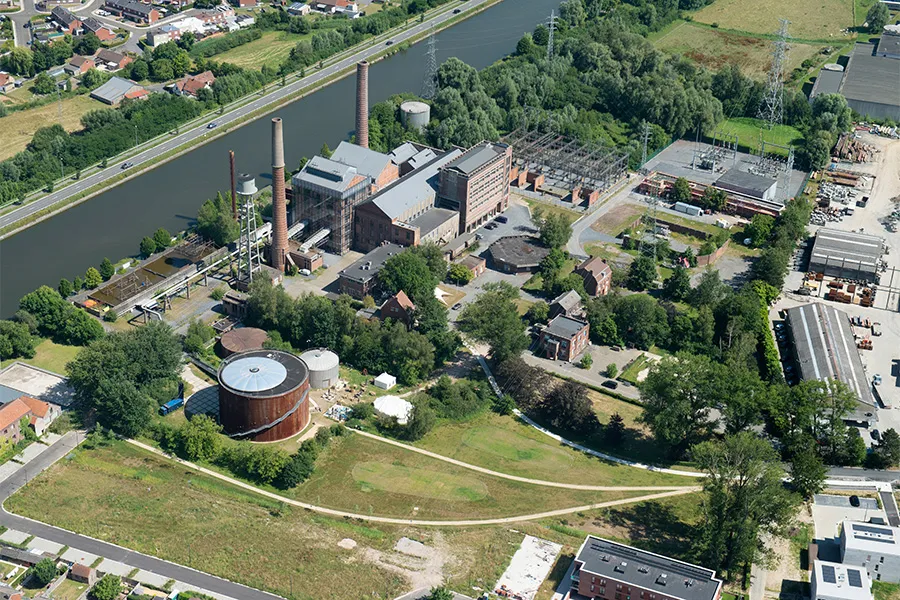
Redeveloping vacant or ageing infrastructure is also part of the solution. “We have been focusing on redevelopment for two decades. 75% of the space we now offer to SMEs consists of former sites that have been redeveloped. This will only become more common in future. Open space in Flanders is all but exhausted, and the shift away from building is a reality,” explains Filip Vanhaverbeke. “That is why we need to look far ahead, towards 2030-2050. Leiedal is also setting a high bar: when we redevelop 10 hectares, we will depave and green 1 to 2 hectares. That, too, is part of making high-quality use of space.”
Former business sites are often still located in their historic position within a residential area. “These businesses may appear to be in the wrong zoning area, but usually they are not. We call these sites, which range from 5 to 10 hectares, ‘purple freckles’. We want to redevelop them for SMEs, while respecting their surroundings. We want to give the right activities the opportunity to grow there, while also benefiting the neighbourhood, for example by creating a cycle route through the site,” adds Steven Vanassche.
Transparent, accurate and evidence-based location advice
To match businesses’ needs with available space, Leiedal is turning to data. The Locus Focus project, a collaboration with POM Vlaams-Brabant and the autonomous provincial company Vera from Leuven, aims to deliver smarter location advice and help local authorities develop targeted policies. It has received grants from both the European Regional Development Fund and Vlaio.
“This is the future: using objective criteria and digital tools, we can provide transparent, accurate and evidence-based location advice. Which businesses are a good fit for a town centre, where living and working are interwoven? Or we can integrate a manufacturing or service business into the business park where it will thrive. The benefits are numerous, for businesses, the neighbourhood and the wider area… We firmly believe this will contribute to a more business-friendly climate. Provided policymakers align their policies with it, of course.”
Park management 2.0
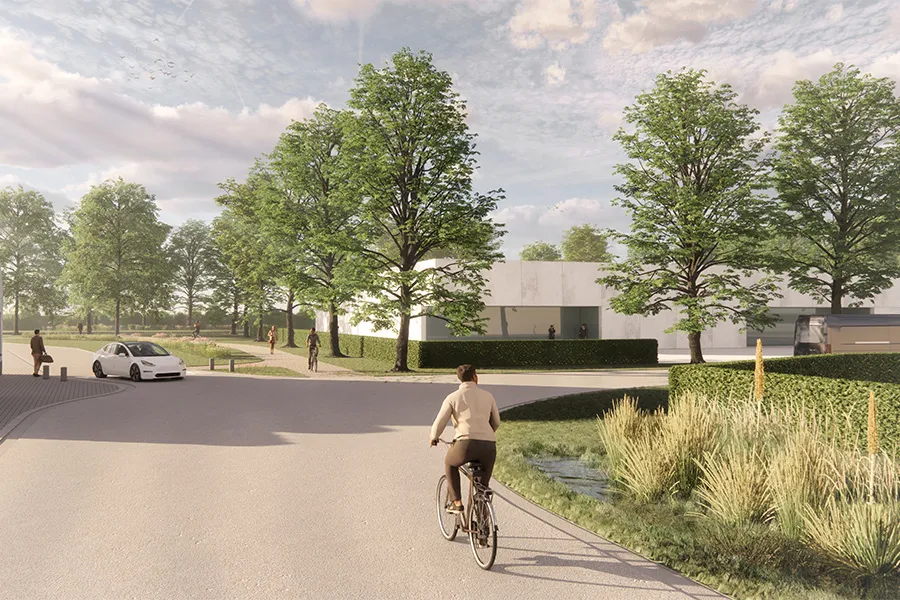
Since the 1960s, the intermunicipal organisation has also managed the business parks it has developed. “We are, in a sense, the good steward responsible for how the site is used. We facilitate contact between businesses and also take care of communal green-space maintenance and public reception facilities,” says Filip Vanhaverbeke.
As part of matching businesses with their needs and the space available, the role of park management is evolving. Steven Vanassche: “If we want to promote circularity, we need to look at how businesses’ resource flows can be aligned. At Kortrijk-Noord business park, for example, the adapted work company WAAK wants to explore how it can work with neighbouring businesses to make better use of energy and residual flows. In practice, that is not straightforward, but we are nevertheless trying to inform and raise awareness.”
New sites and redevelopment projects can start with a blank slate, offering many more possibilities. “We are looking at what could be done around energy sharing or an energy community involving several businesses. The Flemish government still needs to develop regulations for this, but at Transfo in Zwevegem, a site that is not divided into individual plots, we are experimenting with alternative energy sources. It will be a place of inspiration for us, for businesses and for young people interested in energy. Hopefully, we can draw lessons from this for the development of regional business parks such as Evolis II and Blauwpoort,” concludes Filip Vanhaverbeke.
Question about this story? Ask your question
Keep following this
Get an email when a new story is published. No account needed.
- ThemeBuilding and using business premises
- SubjectGeneral







