




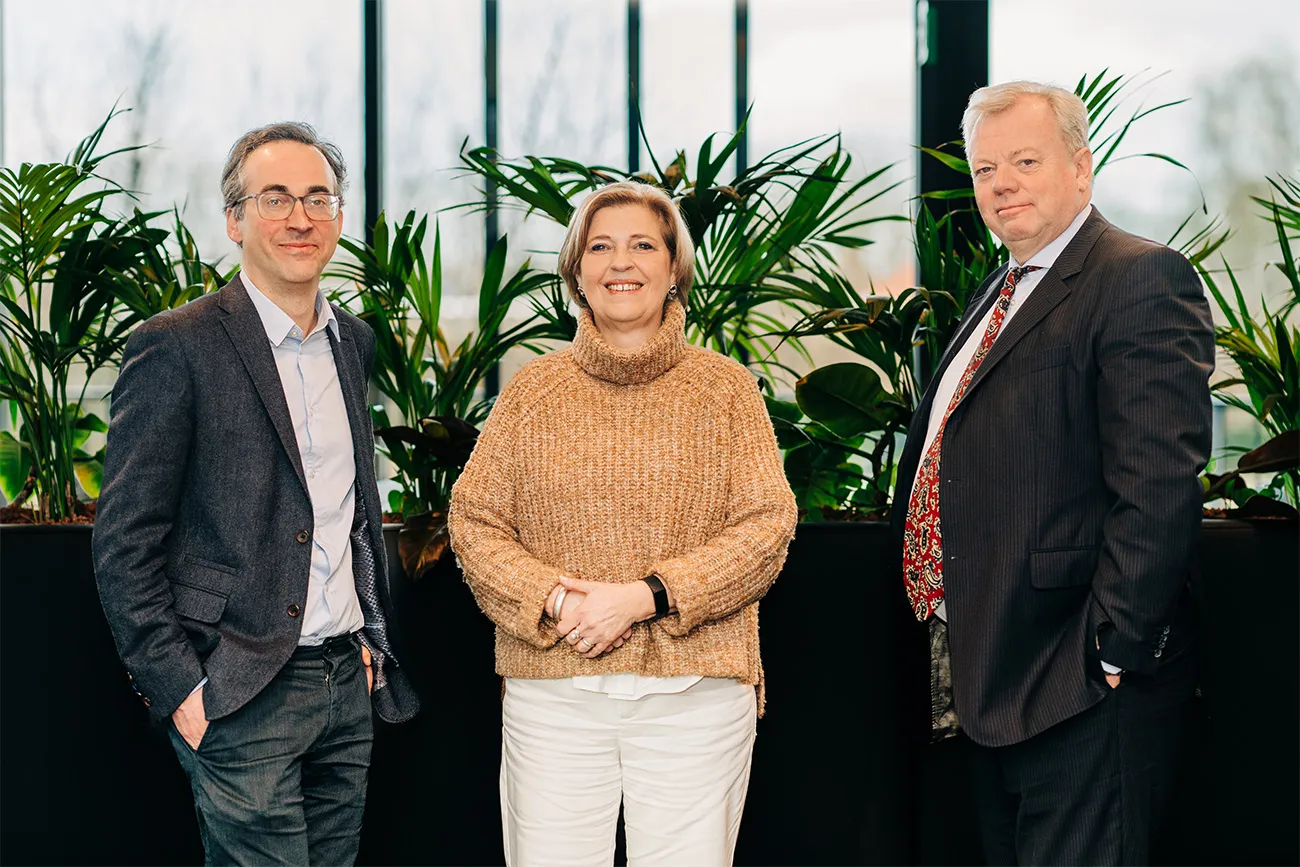
Interview with Henk Vansteenkiste (Hict), Karin Scheerlinck (Surgi-Tec) and Pascal Verdonck (UGent)
“Now is the time to innovate in healthcare”
It is almost three years since the coronavirus pandemic struck our country with full force. Fortunately, the virus has now been brought under control and the healthcare sector can turn its attention to other challenges. Business Vlaanderen brought three business-minded experts together for an update: Henk Vansteenkiste, COO of Hict, a consultancy advising healthcare providers, suppliers and the public sector worldwide; Karin Scheerlinck, CEO of Surgi-Tec, which develops and manufactures implants for oral and maxillofacial surgery; and Pascal Verdonck, professor of medical technology at UGent and board member of innovation cluster Medvia and the Belgian Association of Hospital Directors.
COVID-19 already seems a distant memory. How do you look back on the crisis that shook our healthcare system to its foundations?
Pascal Verdonck: It has indeed been a difficult time. But I want to focus on the positives. Some healthcare providers worked incredibly hard, with great commitment. They received considerable public appreciation for it. We have all come to realise just how important good, high-quality healthcare is. And more than ever, we recognise that health is about much more than the physical: it also has important mental and social wellbeing dimensions. COVID also accelerated the digital transformation of healthcare. I am thinking, for example, of monitoring COVID patients through mHealth applications and telemonitoring.
Henk Vansteenkiste: We saw this around the world: healthcare digitisation received a similar boost everywhere. Many initiatives that were at the pilot stage were rolled out on a large scale more quickly, such as digital patient registration and coronavirus apps. There was a great deal of investment. We also noticed that the crisis accelerated collaboration between different organisations. Unfortunately, some of that momentum is fading again. We should be building on it to prepare healthcare for the future.
Karin Scheerlinck: In spring 2020, we, like many other medtech companies, saw the market grind to a halt. We quickly realised this would be a serious crisis. Since the doctors we supply were only allowed to perform urgent procedures, we stopped production. Fortunately, we were able to make use of temporary unemployment schemes. That helped us get through the crisis period in good shape. Our turnover fell by a third in the first year, but activity picked up quickly again in 2021 and we achieved our best result ever. We used the time we had to further digitise and fine-tune our processes. We are now reaping the benefits.
What is the biggest challenge facing Belgium’s healthcare sector today?
Pascal Verdonck: We need to transform our healthcare system, but in a way that preserves its strengths. Belgian healthcare is highly accessible and organised on an equitable basis. No one should be excluded. But it also has a number of weaknesses. It is complex, the system is costly and it contains inefficiencies. Think of it like a game of pick-up sticks: “our system looks a mess, but usually works well”. And if you try to move one stick, the whole structure could collapse. Since we cannot start with a blank slate, the only option is to innovate within the existing system and organise things as effectively as possible.
Henk Vansteenkiste: Reform is becoming increasingly necessary. The financial position of hospitals worsens year after year: 8 out of 10 hospitals are now operating at a loss. This is holding back investment. A study by Belfius shows that investment in our hospitals fell by almost a quarter between 2018 and 2021. This means clear choices need to be made, so that available resources are spent on investments with the highest return on investment. Hospital networks remain a challenge, but they could deliver even greater efficiency. We see a willingness to work together, but often there are many sensitivities to overcome.
Pascal Verdonck: This really should be the moment for hospital networks to work together to eliminate waste from the system, then reinvest some of the savings in technology and take a step forward. The problem is that existing processes are often digitised as they stand, so the inefficiencies are carried over into new systems. The government should keep a closer eye on this and address the governance of hospital networks. Politicised boards are often a barrier.
And we have not yet touched on labour shortages. Since the pandemic, the problem seems even more acute, particularly in healthcare-related professions.
Henk Vansteenkiste: A study by the Federal Knowledge Centre for Health Care, KCE, found that job satisfaction among nurses has fallen sharply and that intensive care teams suffered a mental blow during the pandemic. As a result, some people are leaving healthcare, and there are not enough new entrants. The result is that workloads are rising further still. This is a spiral that is worrying many sector leaders.

Pascal Verdonck: Many people also approach life differently today. Work-life balance, or what I call “life pressure”, can sometimes tip too far. Hospitals, for example, are finding it much harder than, say, 5 years ago to recruit doctors and highly qualified staff for weekend shifts. And a great many people in healthcare work part-time, even though hospitals have to operate 24/7. The willingness to work outside conventional hours has gone. Highly motivated people risk losing their motivation because of other people’s attitudes…
Karin Scheerlinck: Our sector is also facing problems. It takes a great deal of effort to find good employees, and to retain them. There has been a shift in mindset: people know there is a war for talent and are more inclined than before to shop around. This year, staff costs are rising dramatically because of indexation. If you also have to offer pay rises to retain good people, that means a substantial investment. Smaller medtech companies need to ensure that higher labour costs do not come at the expense of investment in innovation.
Despite everything, Belgian healthcare enjoys a good reputation abroad. How can we ensure there is enough innovation to safeguard the system’s quality in the longer term?
Karin Scheerlinck: We still have major strengths. If you are doing research and development, everything is close at hand here. When we want to launch something new, the university or hospital is nearby, so it is easy to set up clinical studies, and so on. We have an ecosystem that is very conducive to innovation, and there is certainly no shortage of brainpower. But we also need entrepreneurship and courage. On the investment fund I advise, it pains me to see that fewer and fewer high-quality funding proposals are being submitted. This suggests that, possibly because of COVID, there is less impactful innovation in biotech and medical devices. We need to keep a close eye on that.

Pascal Verdonck: One of the most strategic decisions the Flemish government has ever made was to establish imec and VIB. As a result, we now have an excellent reputation and a strong network of pharma, biotech and medtech companies, which together form the Medvia cluster. We need to keep investing in this: continuing to translate academic research into practical innovations. And we need to ensure that these start-ups also have a good home market where they can test and sell their products. That is the only way we will continue to reap the rewards of our investment in development. A new European regulation is making it particularly difficult for medtech companies to get their products certified. We must be careful that too many do not relocate to the US because of certification.
Henk Vansteenkiste: Belgium is a small market, ideal for testing products quickly. But the government needs to facilitate this too. For developments in mHealth, for example, the validation process is too slow compared with Germany. Through our organisation in the Middle East, we also see a need for a great deal of expertise to realise the region’s ambitions. They are looking closely at European companies to help take their healthcare to the next level. This creates real opportunities for our entrepreneurs, provided they have already proven the quality of their products in their home market.
Question about this story? Ask your question
Keep following this
Get an email when a new story is published. No account needed.
- SubjectGeneral







