




How can external management participate in a family business?

Looking for future growth and success
The quality of management is a key factor in a company’s success. In today’s ‘war for talent’, it is hardly surprising that many family businesses are looking for structures that allow external managers to participate. The aim is to secure the creation of shareholder value over the longer term.
An attractive incentive scheme linked to value creation is, of course, an excellent motivator for management. It also helps a family business focus on the long term. Family businesses must ensure that management’s interests are aligned with those of the family shareholders. This is known as an alignment of interests. To achieve this, most business owners consider share options or direct participation. However, these systems have their limitations.

Share options or warrants
Share options or warrants (subscription rights for shares) in the family business itself are attractive because of the particularly favourable tax framework for employees. This involves upfront taxation, followed by a tax-free liquidity event, for example after 3 to 5 years.
Direct participation
Allowing key managers to participate directly is not common in a family business. The intention is not to give third parties a say in matters such as the sale of the company. Nor is it intended for external managers to remain shareholders if they leave the business.
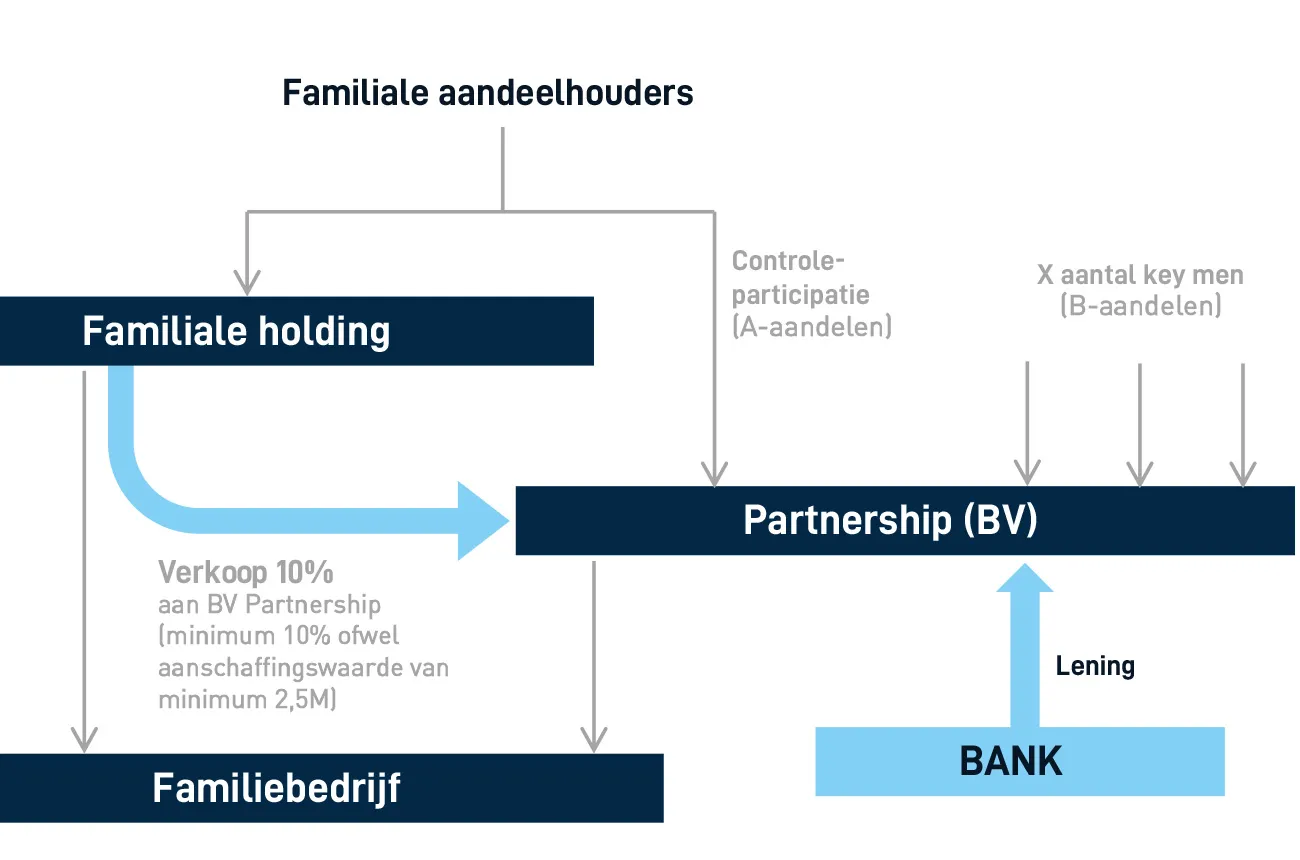
ALTERNATIVE: The partnership structure
In many cases, the partnership structure is a solid alternative, offering benefits to the company and its family shareholders as well as to the managers involved. A partnership is a separate legal entity that takes a stake in the business and allows key management figures to participate. This stake is financed through a bank loan, possibly combined with a vendor loan (a deferred payment from the selling family shareholder), and supplemented by a contribution from the managers themselves. This contribution, also known as a ‘buy-in’, requires a financial commitment from the managers.
This structure benefits all the parties involved. From the family shareholders’ perspective, it is crucial that the partnership is limited to a purely financial stake. This means external managers cannot block transactions. External managers do not remain shareholders if they leave the company due to dismissal, illness, death or retirement. In that case, they do receive an exit payment.
You can also tailor the rules in full, for example by setting criteria for joining, leaving and exclusion, or specific valuation formulas that reward loyalty. Examples include good leaver, bad leaver and early leaver clauses.

The perspective of those joining
For those buying in, the entity acts as a financial lever because the partnership takes on part of the financing (a bank loan and/or vendor loan). The structure also allows for optimisations that would not be possible with direct participation. And the key people’s risk is limited to their investment in the partnership.
The opportunity to participate in the value creation of a family business through a partnership structure can motivate top talent to build their careers within a (larger) family-owned business, and creates a lasting bond. This approach also makes it possible to align the interests of shareholders and management over the long term. It is a clear win-win for all parties.
Question about this story? Ask your question
Keep following this
Get an email when a new story is published. No account needed.
- ThemeBusiness transfers and acquisitions
- SubjectGeneral







