




Double interview with Koen Dejonckheere and Hilde Laga, CEO and Chair of Gimv
Text Björn CrulImage Tjorven
“As in gardening, we need to invest in the biodiversity of the economy”
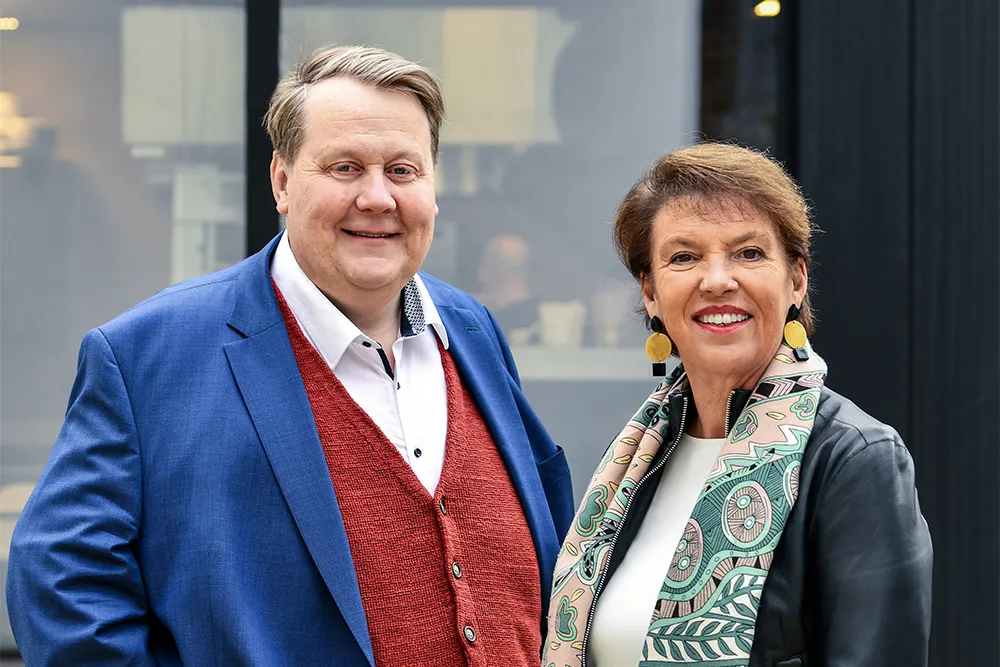
Subject to approval from the competition authorities and completion of the necessary checks under the foreign direct investment rules, WorxInvest will replace the Flemish government as Gimv’s reference shareholder during the course of this year. 44 years after its founding, the listed investment company will then be entirely in private hands. With stakes in 59 European companies, valued at 1.6 billion euros, the holding company is a major private equity player in Belgium and neighbouring countries. Its head office is in Antwerp, but it is led by a West Flemish duo: Koen Dejonckheere (CEO since 2008) and Hilde Laga (Chair since 2016): “Now that we are anchored once again in Flanders, all our attention can return to growing our companies.”
Over the past four decades, Gimv has evolved from a public Flemish investment company into a listed European private equity player. Which milestones have been important to its success?
Koen Dejonckheere: The stock market listing in 1997 was an important moment. It led to politicians stepping back from the organisation. Governance was depoliticised and professionalised. Internationalisation took shape under the chairmanship of Herman Daems, who took office in 1999. An initial deal, the acquisition of Alpinvest, fell through. But Gimv subsequently succeeded in acquiring Halder Invest in The Hague. This gave us offices in the Netherlands and Germany. It was also the period when we began investing in venture capital funds in Boston and San Francisco, from which we learned a great deal.
Hilde Laga: The 2008 financial crisis was certainly another milestone. It prompted us to be more selective in our investments: fewer, but better chosen with a view to future growth. Gimv also went on to establish fully fledged local offices with their own teams. This local expertise enabled us to build further on a portfolio of growth companies with international ambitions, as our slogan puts it: Building leading companies.
Another turning point was the adoption of thematic investment platforms in 2012, which continue to shape the strategy today.
Koen Dejonckheere: With Urbain Vandeurzen as chair, we developed a vision centred on major global trends and decided to group and manage our investments through four, later five, thematic investment platforms: Consumer, Healthcare, Life Sciences, Smart Industries and Sustainable Cities. In each area, we focus on companies offering solutions to the world’s megatrends, creating value, with international potential and operational excellence. By pooling our expertise and connecting companies in similar sectors, Gimv delivers real added value. During the coronavirus pandemic, for example, we brought CFOs together country by country to share information about support measures and their experiences with banks. This cluster-based approach works.
Hilde Laga: In recent years, we have continued to focus on our investment platforms and further developed the value we add. We are scaling back our investments in third-party funds. Gimv is made up of industry experts, engineers and strategic advisers, far more than just financial professionals. We can now deploy our resources with greater insight in larger deals with higher returns. We are targeting fewer investments, but larger tickets.
Koen Dejonckheere: At one point, we were shareholders in 129 companies. Today, that number is 59, while the portfolio’s value has risen from half a billion to 1.6 billion. By investing in fewer companies, we can monitor them more closely. Strong management and a good board of directors are essential to securing future growth.
The global economy has been volatile since 2020, following a succession of crises and conflicts. Has this affected Gimv’s strategy and investment policy?
Hilde Laga: At the start of the pandemic, we were presented with some opportunistic investment opportunities, for example in face masks. But we did not let ourselves be distracted and stuck to our strategic plan. Some trends have accelerated, though, including digitalisation, working from home, questioning our dependence on China as a supplier, and the move towards a more sustainable economy and society. Our investment platforms are still on the right track to help shape these developments.
Koen Dejonckheere: I think our society as a whole is now more aware than ever of the importance of local production, a healthy domestic economy and the benefits this brings to everyone. Our focus on the Benelux, France and Germany fits with that. We continue to look at both traditional sectors with the potential to innovate and new opportunities. Our oldest investment today is Grandeco, which we invested in in 2007. The company makes wallpaper, but after some difficult years it has repositioned itself and is now focusing fully on digital printing and antibacterial wallcoverings. Acquisitions in the Netherlands and UK will enable it to continue growing.
Last year, the Flemish government decided to realise the value of its remaining 27.65% stake in Gimv. WorxInvest became the new reference shareholder, with roots in the Flemish business community and a strong base in Flanders. Was this local anchoring essential for Gimv?
Hilde Laga: This Flemish anchoring was important both for the organisation and for the Flemish government. As directors, we wanted a new shareholder committed for the long term, able to strengthen the strategy, rooted in Flanders, but also able to give us international wings for the future. We have found such a partner in WorxInvest, the parent company of SD Worx.
Koen Dejonckheere: I have great respect for the way the government handled the process, guided by its own view that our investments are no longer part of its core business, while showing due respect for a listed company like Gimv. I also understood from Minister Diependaele that consolidation in Flanders was a condition sine qua non for the sale of the stake. It was also gratifying that several entrepreneurs showed an interest in keeping Gimv in Flemish hands.
Analysts also welcomed WorxInvest’s acquisition and issued a buy recommendation. Over the past year, the share price fluctuated between 36 and 47 euros. Market capitalisation currently stands at around 1.2 billion euros, while the portfolio of underlying companies is worth around 1.6 billion. Is Gimv, a sound investment for the prudent investor, being undervalued?
Koen Dejonckheere: In the current stock market climate, we are seeing many holding companies trading at a discount. That is also true of Gimv, after years of trading at a premium. On the other hand, Gimv remains a “buy and hold” stock because we have a stable and attractive dividend policy. Many individuals are shareholders, and some families have built up large holdings over the years. It is a way to invest in private equity without taking on major risks. It is even the only way to invest in Flemish technology players such as Cegeka or Televic.
Personally, I think the stock market has a problem. The range of available investments is becoming narrower. There are no IPOs, and trackers and ETFs from large firms such as BlackRock are driving consolidation, with investors looking only at stock market indices. Small and mid-caps are finding it very difficult as a result. That is a shame, because, just as in gardening, you need biodiversity in your economy, with investment in small, medium-sized and large companies. We need to cherish that ecosystem.
Hilde Laga: Regardless of the share price, I think it is more important that Gimv has been selected for the Euronext BEL ESG Index. Sustainability is a topic close to our hearts. How do we ensure not only a return on investment, but also a return on society? An ESG audit is a standard part of our investment assessments. We also measure progress against ESG criteria, looking at how a company addresses environmental and social issues and governance.
Finally, what are your expectations for 2024, both for Gimv and for Flemish SMEs?
Hilde Laga: Gimv is having a very strong year. The first six months of our financial year, which does not coincide with the calendar year, were excellent. Our companies are growing substantially faster than the economy. We owe that to our broad portfolio, good sector diversification and the oversight Koen and his teams provide to our companies.
Koen Dejonckheere: We still have cash on hand to invest if good opportunities arise. But we have sown the seeds over the past period, and now we need to cultivate the ground and ensure a good harvest. More generally, we are seeing and hearing a mixed picture among Flemish SMEs. Inflation and rising interest rates have hurt some companies and sectors. But I note that every industrial estate in Flanders still sells out quickly. And when a property becomes available, such as the former DPG Media printing works in Lokeren, it quickly finds a new use, in this case as the robotics department of Stow. One of the biggest challenges for all companies, it seems to me, is how they will achieve strong growth if they cannot find enough new people. We need brains and hands. And that will never change.
Question about this story? Ask your question
Keep following this
Get an email when a new story is published. No account needed.
- SubjectGeneral







