




Dewaele Vastgoed on changing renovation regulations
Text Roeland Van Den DriesscheImage Dewaele Vastgoed

The renovation obligation, the asbestos inventory, the asbestos certificate … In recent years, the Flemish government has launched numerous initiatives to make the building stock carbon-neutral and asbestos-safe. This is good news for people and the environment, but businesses are not always clear about which obligations they need to meet. They are also running out of time to get compliant. Dewaele Vastgoed sets the record straight.
By 2040, the Flemish government aims to make Flanders asbestos-safe through a new action plan. Research has shown that the presence of asbestos in a building poses a risk to the environment. “Although the production and use of asbestos and asbestos-containing materials have been prohibited for more than twenty years, 2.3 million tonnes of asbestos-containing material remain in our buildings. In commercial buildings, the figure is as high as 689,000 tonnes,” says Siska Dejonghe of Dewaele Vastgoed.

Asbestos Phase-out Action Plan
That is why the Flemish government launched the Asbestos Phase-out Action Plan. “The focus is on asbestos safety, because being asbestos-free is simply not feasible. There is still a lot of asbestos in the soil, for example, and tackling that too would mean having to demolish certain buildings completely, causing major disruption. Hence the decision to phase out asbestos gradually.”
The asbestos certificate is already an important tool under the action plan. “A certificate is currently required when transferring a property built before 2001. By 2032, the measures for this category of buildings will be tightened, and every owner will have to hold such a certificate, even if they have no plans to sell the property. In addition, two target dates have been set: the most high-risk asbestos applications, such as roofs and façades, must be removed by 2034, and all other possible asbestos applications by 2040.”
A complex matter
Businesses that are caught unawares would be well advised to take action. “A complete renovation is not necessarily required, but businesses should bear in mind that the renovation obligation has also been in force since 1 January 2022. And it can have a major impact. The measure is much more complex than you might think,” Siska continues.
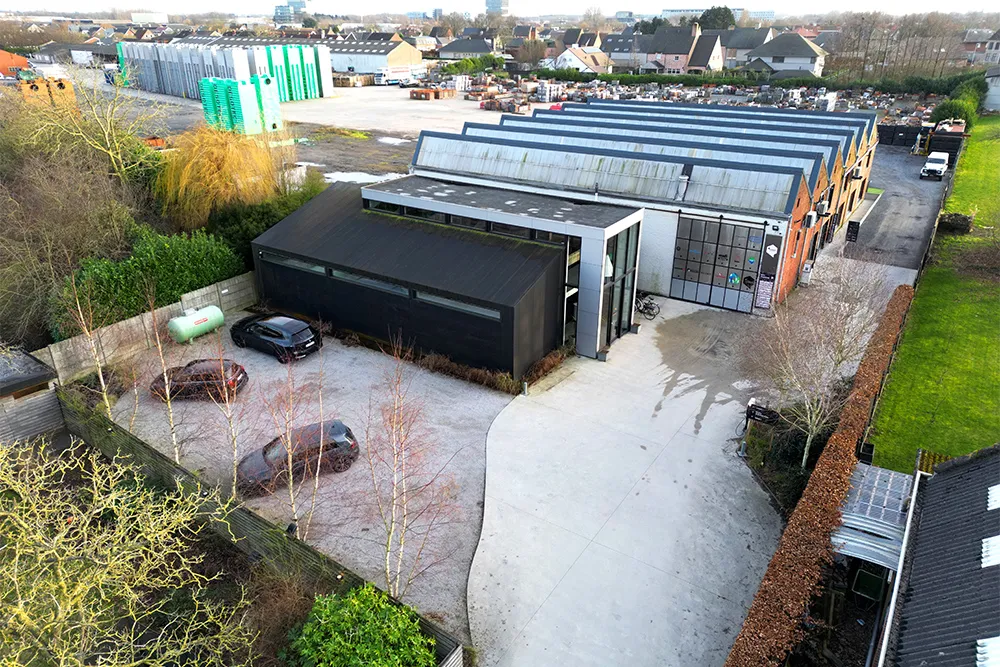
Different rules apply to properties smaller than 500 m², for which an EPC is already mandatory, than to properties exceeding that floor area. “Smaller properties have a different renovation pathway, with the emphasis mainly on insulation and building systems. For larger properties, there is also an obligation relating to renewable energy. A large property, for example, must have a renewable energy share of at least 5% to achieve EPC label E. In practice, however, this is not always straightforward. A business occupying the ground floor of an apartment building, for instance, has far fewer options for energy-efficiency improvements than a standalone unit in an SME zone.”
Time is running out
Time is running out, however, as commercial buildings must achieve label E by 2030. “That may seem a long way off, but it isn’t. That is why we strongly advise businesses to take the necessary steps now. A first step could be to map your energy consumption. Businesses with several sites, and investors with multiple commercial buildings in their portfolios, should certainly not wait too long to do this. In any case, renovation is always a positive story. The investments you make will always enhance the value of your property,” concludes Siska Dejonghe.
Een zakelijke vraag aan Dewaele? Get in touch
Companies in this story

Keep following this
Get an email when a new story is published. No account needed.
- SubjectGeneral
- CompanyDewaele







