




Despite economic uncertainty, Voka is optimistic about the future
Text Björn CrulImage Voka, Administratie Wegen & Verkeer
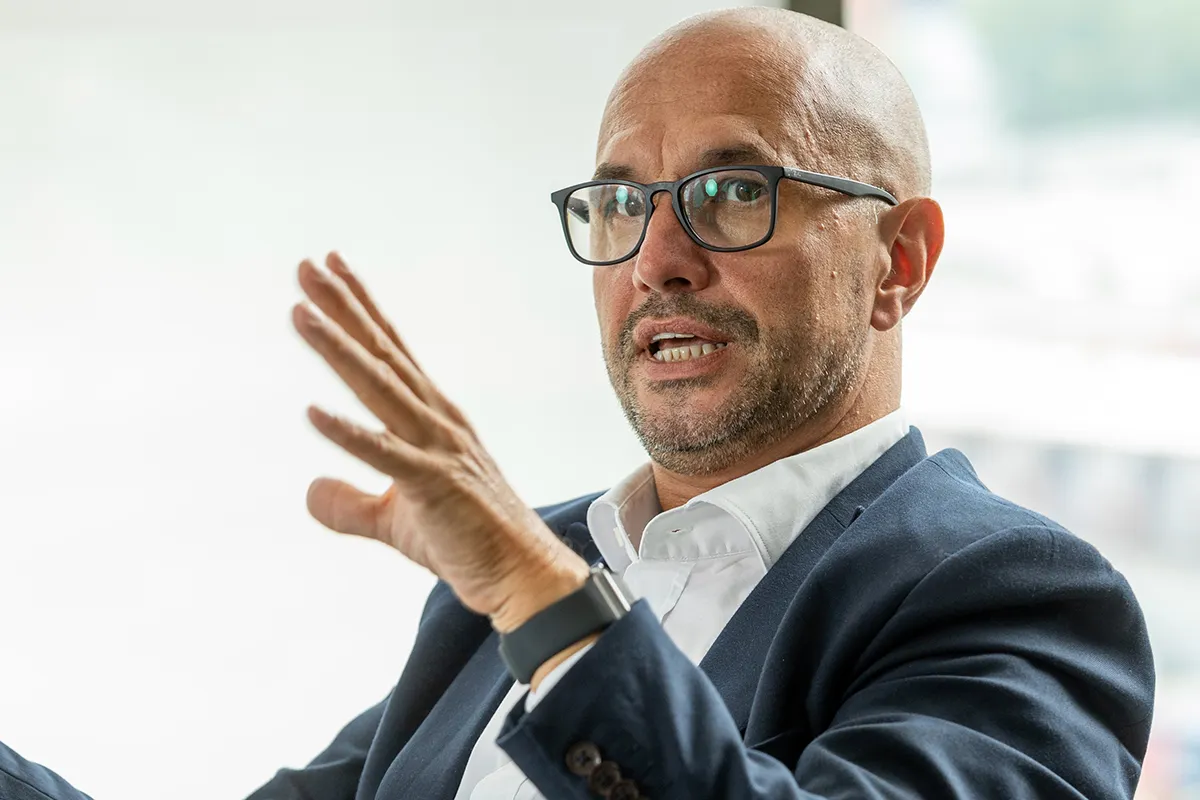
“The Kempen is Flanders’ economic turbo”
The Geel-Turnhout region is one of the fastest-growing economic regions in Flanders. It has strong ties to the chemical cluster in the Port of Antwerp and is home to several major pharmaceutical players and important manufacturing companies. Yet challenging times lie ahead, according to a recent survey by Voka. How is the region faring? We asked Tom Laveren, managing director of Voka Mechelen-Kempen.
Companies in the Turnhout district have come a long way. Voka Mechelen-Kempen conducted an economic analysis and reached a surprising conclusion. Tom Laveren: “If you look at the period from 2005 to 2023, just short of 20 years, you see a huge rise in gross domestic product. GDP is the sum of everything we make, do and produce. Over those 19 years, GDP doubled. That is enormous. This puts the Kempen region at number 1 in Flanders for growth.”
The Kempen region’s value added now amounts to €26 billion. “If you look under the bonnet, you see that industry is the driving force behind that value added. Industry, with the strong presence of the pharmaceutical sector and manufacturing companies, for example, accounts for 40 per cent of value added. If Flanders is the engine, this region is Flanders’ ‘turbo’, the region that is really moving forward.”

Indicators are flashing red
Nevertheless, several indicators are flashing red, according to the latest business survey. 1 in 5 companies expects to contract, possibly even undergoing restructuring. “We are facing structural problems. Labour costs have risen by 20 per cent over the past four years because of automatic indexation. Production and productivity have not increased at the same rate,” says Voka’s CEO. “Many plant managers in the region have to explain this to their international parent company. Those are difficult conversations.”
But that is not the only issue. Van Laveren also points to energy bills. “This is a disadvantage, particularly for energy-intensive companies. Competition from foreign companies with much lower energy costs is fierce. We are therefore watching to see what the new federal government will do. It really needs to deliver, because it has the power to make our companies more competitive.” Another problem is that the chemical sector is in a downturn. Is this also affecting companies in the region with links to the cluster in the Port of Antwerp? “This industry is going through a very rough patch. It is the most difficult period in 15 years. But I do not want to be too negative. The Kempen and Mechelen regions combined managed to attract almost €500 million in foreign investment in 2024. To me, that shows we have some very strong, innovative companies in our region. Credit is due to the CEOs and plant managers who are pulling out all the stops to secure their companies’ future,” says Tom Van Laveren.

Local authorities must step up
More space for businesses is needed to further realise the region’s potential. This is Voka Mechelen-Kempen’s top priority. “629 hectares of industrial land in the Mechelen-Kempen region are blocked. That is 8 per cent of all industrial land in the region. We are calling for these sites to be given the green light quickly. By 2040, the building shift will mean that, in principle, no new sites can be developed. Meanwhile, companies’ demand for space continues to grow.”
Another essential issue, and a frequent source of frustration, is faster, smoother permitting. Tom Laveren: “One in three permits in this region is discontinued before completion. Often, that is because the process takes too long or is too complex. That means the investment does not go ahead. This is damaging to our economy. It means fewer jobs, less investment and also less income for the city or municipality.” Local authorities have important tools at their disposal when it comes to space and permits. But Voka expects more. “Local authorities can also make a difference in the labour market by getting more people into work. One in five people in this region is not looking for work. Across the region as a whole, that is 91,000 people. That number is falling only slowly. Yet we need all those hands if we are to remain Flanders’ growth engine.”
The motorway is no longer a fast route
One issue that must certainly be tackled in the coming years is the E313. “The length of the traffic jam towards Antwerp has increased by 44 per cent in just 10 years. In the other direction, towards Hasselt and Liège, it has even doubled. This is no longer sustainable,” says Tom Laveren. “We are therefore calling for 2 x 3 lanes in both directions, especially now that the Oosterweel works are taking 3 years longer than planned. We also support a smart kilometre charge for all road users. The E313 is simply no longer a fast route.”
Question about this story? Ask your question
Keep following this
Get an email when a new story is published. No account needed.
- SubjectGeneral







