




Carl Baekelandt and Manu Tuytens on 100 years of Concordia Textiles
Text Roeland Van Den DriesscheImage Mathieu Van de Sompel
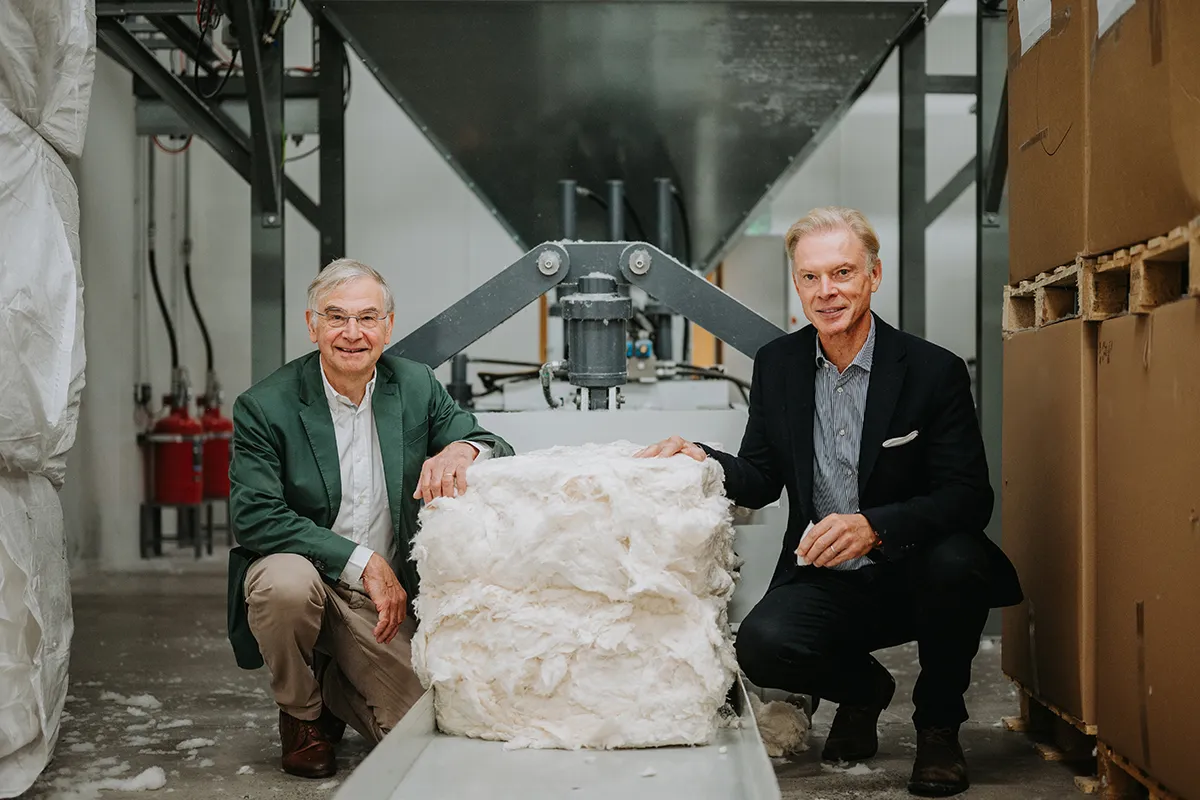
“We are so strong because we have retained our know-how in Flanders”
The textile industry is one of the oldest sectors in Flanders. But globalisation, competition from low-wage countries, shortages in the raw materials supply chain and geopolitical tensions are making life difficult for the sector. Yet centenarian Concordia Textiles of Waregem is thriving. The family business proves that innovation and resilience are the keys to keeping industrial activity rooted in Belgium. CEO Carl Baekelandt and chairman Manu Tuytens explain how they are preparing their company for the future.
Concordia Textiles has come a long way. You have survived several crises, and the company is now on a firm footing and delivering strong figures. How did you achieve this?
Manu Tuytens: “Our story began in 1925, when my grandfather and a partner started a weaving mill in Waregem. After the Second World War, my father Albert took over. He was the one who brought the company to where it is today. He was technically skilled, socially minded and financially astute. That family business spirit drove us forward for decades. When Carl joined us in 1998 and globalisation hit hard, we had to reinvent ourselves. Customers flocked to China. We deliberately opted for a two-pronged approach: winding down older activities while investing in new markets and technology.”
Carl Baekelandt: “The turn of the millennium was a turning point. Concordia mainly produced basic textiles, but our model collapsed under competition from far cheaper Chinese products. We decided to invest radically in more technical textiles. We modernised the machinery in Waregem and built our own production operation in China. At the same time, we began making targeted acquisitions in Europe. This created a mini-multinational built on several pillars. Today, that is our greatest strength: we do not depend on a single product, customer or region. Diversification and innovation have kept us going all these years.”
So Concordia has made a clear shift. How did you manage that transition?
Carl Baekelandt: “Until the late 1990s, everything revolved around operational efficiency: producing a little faster, a little better and a little more cheaply every time. When borders opened and competition intensified, we reshaped the company into three clearly defined business units: workwear, fashion and other innovative applications involving textile fibres. This gave us a clear framework and laid the foundations for all subsequent development and investment. Above all, we listen to what the customer needs and consider how we can take care of everything for them.”
Manu Tuytens: “That shift was decisive: no longer focusing on volume for its own sake, but on value and relevance. From local to global player, from production to market, and from follower to innovator. Those three steps still shape the way we move forward today.”
You employ 1,100 people worldwide, have a turnover of €110 million and operate in China, Bangladesh, Spain and Germany. Yet the Waregem site remains crucial. What are the benefits of manufacturing in Flanders?
Carl Baekelandt: “Belgium is one of the most expensive manufacturing countries in the world. But we build on our strengths, namely our knowledge and capacity for innovation. In Waregem, we have everything under one roof, from weaving and dyeing to coating and testing. That gives us a clear competitive advantage. What is more, major European customers, particularly in defence and medical applications, explicitly ask for local production and traceability.”
Manu Tuytens: “Diversification has genuinely been our lifeline. It has helped us weather the banking crisis, the COVID period and now geopolitical uncertainty. But that strength is only possible because we have retained our know-how in Waregem. When a customer comes to us with a problem, we can offer solutions straight away. That knowledge base in Flanders makes all the difference.”
After 100 years, Concordia is still a family business. How does that family character contribute to your success?
Manu Tuytens: “A family business takes a long-term view. We are not chasing quick returns, but want to pass a healthy company on to the next generation. That means we sometimes make difficult choices that hurt in the short term but are necessary in the long run. The values we learned at home, respect, honesty and cooperation, remain at the heart of what we do. And we combine them with a constant drive to innovate.”
Carl Baekelandt: “Those family values create stability and trust, both internally and externally. Employees can see that this is not a business driven purely by financial considerations, but one with a history and a future. At the same time, the family framework gives us the freedom to invest in new technology or markets, even when the return is not immediately apparent. That is an important driver of our growth today.”
Europe is pushing the fashion sector towards greater sustainability. What are you doing in concrete terms?
Carl Baekelandt: “Unfortunately, we have to acknowledge that the transition is progressing more slowly than anyone expected. Europe has high ambitions, but too often they remain noble ideas that are not translated into practice. With no clear legal framework, circular products remain more expensive than virgin materials, which is holding back demand. We have done our part: six years ago, we launched Purfi, our recycling technology that upgrades used fibres to virgin quality. The line can process 3,000 tonnes of textiles a year. Technically, we are therefore in pole position, and we already have partnerships with major retailers. Only when Europe decides that every product must contain a minimum proportion of recycled fibres will things really get moving.”
Manu Tuytens: “It is a classic chicken-and-egg situation: prices will only become competitive once the whole sector makes the switch. And that requires clear rules, or restrictions on those who do not get on board. Unfortunately, we are still in a transition phase, which demands a great deal of resilience from companies that want to move forward.”
In a globalised world, the story does not stop at Europe, of course. What obstacles do you still see on the road to that transition?
Carl Baekelandt: “Europe has the world’s strictest environmental and production standards, yet its borders are open to products that do not meet them at all. That completely distorts the playing field. Add our high labour and energy costs, and you can see how difficult it is to remain competitive here. We cannot impose circularity ambitions on European companies while importing goods that do not meet the same rules. The situation in Liège is a telling example: three billion parcels arrive there every year, and only a fraction are actually checked for counterfeit goods. It shows just how difficult the situation is today.”
Geopolitical tensions are also creating opportunities. Defence in particular is a growth area. How important is that market to you?
Carl Baekelandt: “Defence has always been an important pillar for us. Before the war in Ukraine, military textiles accounted for a third of our turnover in Waregem. Today, that figure has risen to almost half. An important point is that this is not a market you can simply enter. You need a high-quality product and the right certifications. We have both.”
Manu Tuytens: “This shows that the decision to diversify our offering further was the right one. Defence may be booming now, while other markets remain under pressure, but our spread of activities makes us less vulnerable.”
Has that foresight been a constant throughout Concordia Textiles’ 100-year history?
Manu Tuytens: “I see it as an art: you have to try to understand something before you can judge it. That applies to a painting, but just as much to a new market or technology. Only when you understand the context can you decide whether it is right for you.”
Question about this story? Ask your question
Keep following this
Get an email when a new story is published. No account needed.
- ThemeBusiness growth and entrepreneurship in Flanders
- SubjectGeneral







