




A conversation with Carmen Willems (KMSKA) and Gunther Broucke (Brussels Philharmonic)
Text Björn CrulImage Joren De Weerdt
“We talk to businesses about content, not money”
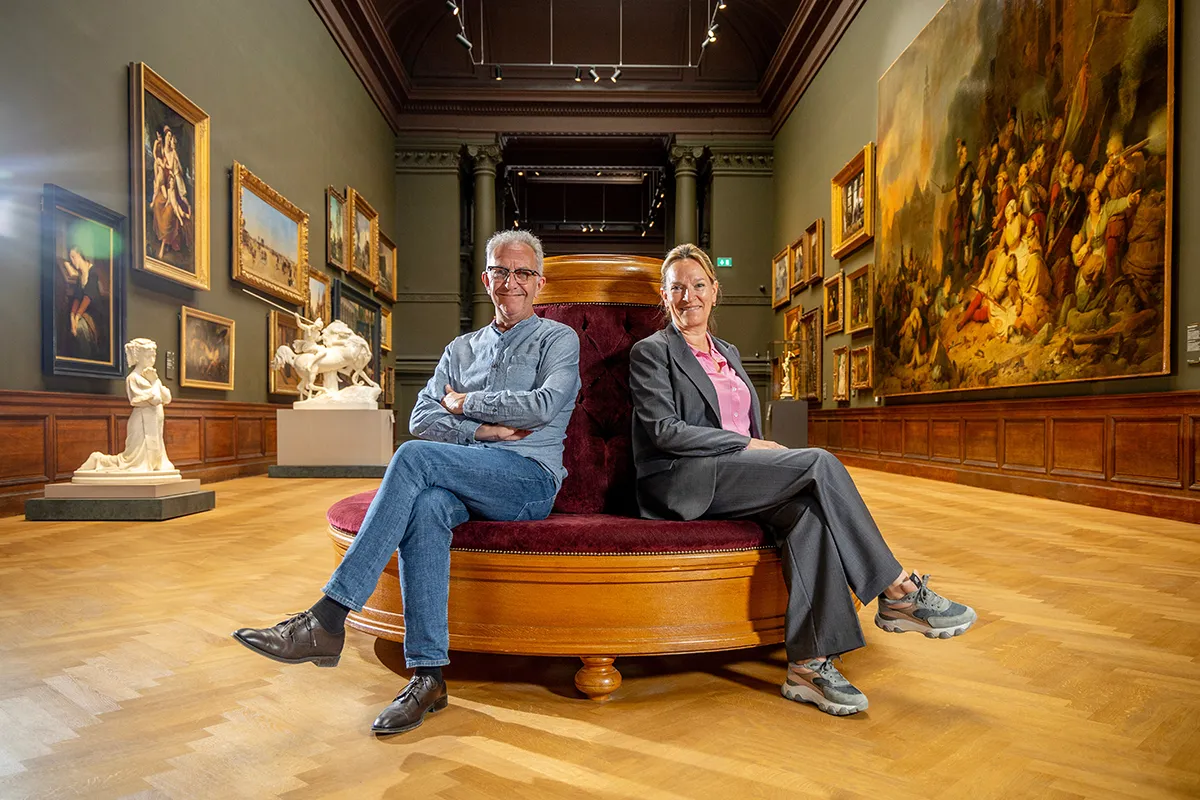
Like commercial companies, major cultural organisations face a range of challenges today. How do you keep innovating and win over your audience, when resources are not unlimited? And what impact is economic volatility having on budgets in the cultural sector? We spoke to two experienced cultural managers: Carmen Willems, General Director of the Royal Museum of Fine Arts Antwerp, and Gunther Broucke, intendant of Brussels Philharmonic and the Flemish Radio Choir.
The economy is going through turbulent times. How are your organisations doing today?
Carmen Willems: I can say with some pride that the KMSKA is doing well. We reopened at the end of 2022, after an 11-year renovation. We can see that the public has embraced our new approach. We have now welcomed almost 1.5 million visitors in less than three years. More important, however, is that our audience is now younger and more diverse than before. Repeat visits are also on the rise. We have worked hard on that, including by programming much more dynamically than we used to. We have a large collection and a fantastic building, but KMSKA wants to be much more than a place to display art. We want to remain relevant and current by telling new stories, which are not based solely on an art-historical perspective but also on the visitor experience. Performances and events bring a new dimension to the building.
Gunther Broucke: I can see that our sector, that of major classical orchestras, has finally recovered from Covid-19. The international touring circuit is only now getting back into gear. That is good news: recently, we were booked for two international tours in 2026-2027, in China and Japan, within the space of a week. Tours like these are important for the musicians and contribute to group dynamics. At the same time, we are asking ourselves which international stages we still want to perform on. After all, every major city in the world has a high-quality orchestra with a loyal audience. We need to make more of our unique strengths. Last year, for example, we performed a concert in Rome featuring film music by a Japanese composer. I can say hand on heart that no other orchestra in the world has that in its DNA in the way Brussels Philharmonic does. The message, then, is to keep renewing and innovating. That is also why we made a conscious decision to join forces with Japanese conductor Kazushi Ono.
Both organisations receive structural support from the Flemish Government. What does the financial picture look like?
Carmen Willems: Our museum is owned by the Flemish Community, which provides core funding for day-to-day operations and the maintenance of the collections. We carry out our work with a team of 130 full-time equivalents and 70 freelance guides. We generate 12 million euros in income from subsidies, ticket sales and events. But our fixed costs alone amount to 14 million. We are doing pioneering work in the museum sector to boost our income. Since reopening, for example, we have raised more than 2.5 million through structural sponsorships, including from Bank Delen and Ackermans & van Haaren. We are now setting up longer-term projects with partners like these, and discussing the content with them too. This creates a level of engagement that benefits both parties.
Gunther Broucke: Our organisation has 135 full-time equivalents, supplemented each year by another 12 to 15 musicians, depending on what is needed. We receive 10 million euros from Flanders through the Arts Decree, thanks to our leading position. We supplement this amount with 4 million in our own income from tickets, performance fees and the tax shelter. This tax incentive means that we also develop content-led projects with a number of companies. It has become a very important form of funding. If it were to disappear, it would create a huge problem.
Carmen Willems: We would like to see the tax shelter scheme extended to the museum sector. The idea has been around for a long time, but we have not managed to get it turned into reality politically. It would be a valuable addition to our funding.
Some companies are experiencing an economic slowdown. Is that affecting your sector and organisations too?
Gunther Broucke: We are not feeling a slowdown at the moment. But the tax shelter is, of course, linked to company profits, which means any impact may take a year to come through. So we will have to wait and see what the future brings. Fortunately, our organisation is not dependent on sponsorship. With private bank Puilaetco, for example, we have set up a foundation for musical instruments. A string instrument costs a lot of money, and it is becoming increasingly difficult for musicians to buy one themselves. On the other hand, you can see such top-quality instruments as strategic investments. Their value has continued to rise since the Second World War, regardless of the crises we have experienced. Our foundation now has 20 instruments with a total value of more than 3 million euros. Investors can join every five years and realise their capital gains, but so far no one has done so. On the contrary, these people feel very involved with “their” instrument and the musician who plays it. Money becomes almost incidental.
Carmen Willems: We have not seen any impact at the museum either, so far. Of course, we are still riding the wave of the reopening. We took the three-year partnership model from the Rijksmuseum in Amsterdam and adapted it to our needs. We are now gradually reaching the point of renewing those partnerships, and so far all the companies have renewed. In our case, too, that is thanks to the relationship and engagement with those partners. We have a group of business leaders who are involved in new stories, for example, how we get young people hanging around on the streets involved, to stimulate their creativity and help them discover the museum. It is a story that engages business leaders, both professionally and emotionally. Our connection with our partners makes me confident about the future.
What do you see as the biggest challenge for your organisation today?
Carmen Willems: We manage a collection that has been built up over centuries and is renowned worldwide. 40% consists of bequests and donations, and the government has also made a substantial contribution to its richness. But today we have no acquisition budget to expand and strengthen our collection. We look with envy at our colleagues abroad who are able to do so. KMSKA, for example, has few works by women artists in its collection. You cannot solve that by buying one work a year. So we want to explore what creative solutions might be possible with private capital. A second area of tension concerns research. We have almost no one on staff who can work on it exclusively, as there is too much else to do. Yet research is part of our remit as a major Flemish institution. We want more resources for it, so that we can remain relevant internationally.
Gunther Broucke: Our challenges are quite similar. The Flemish Community is taking responsibility, but at the same time it is not: every benchmark shows that comparable institutions abroad receive more government funding. We have often discussed this with politicians. But I have been in this business since 1998, and nothing fundamental has changed. I no longer get worked up about it. We must, and want to, compete internationally with Brussels Philharmonic and make a difference. So we keep doing that with fewer people and resources than comparable institutions. At the same time, the challenge is to look 20, even 30 years ahead and ask ourselves what the orchestra of the future will look like. Where will innovation come from? Which musicians will be part of it? How do we maintain our support among the public? In short, how do we continue to make a difference in the future?
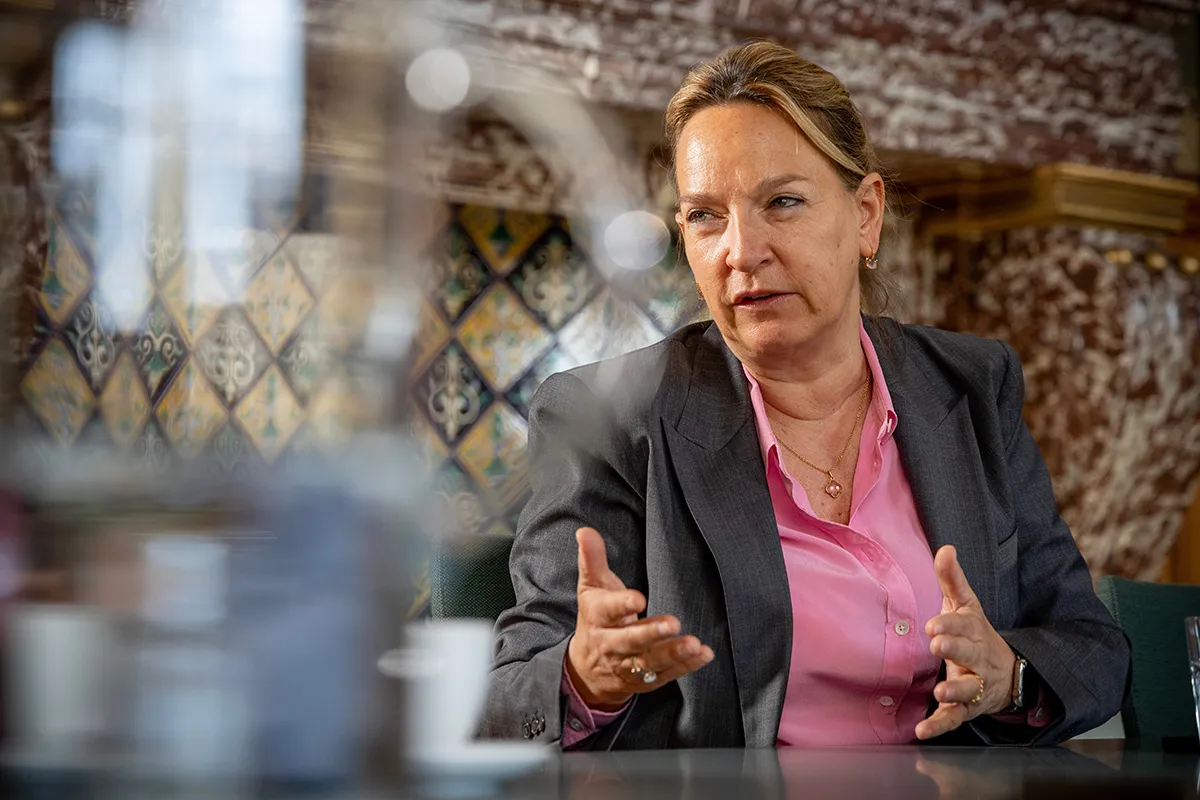
What does it mean to lead a cultural ‘business’? What is your main role?
Carmen Willems: I was brought in in 2017. The museum had already been closed to the public for five years. Belief in the project had ebbed away. Fortunately, we were able to change that perception, and the organisation underwent a major transformation, changing its approach and becoming a cultural institution with an impact. I am an enabler who believes we need to stay creative and gives staff the confidence to keep experimenting. People respond to that. They like working here. We do not think in terms of a 9-to-5 mentality, and those who embrace that become loyal ambassadors. Last week, the sales managers of the major Dutch cultural institutions came to visit. Many of them came to congratulate me on how agile we still are as an organisation. It is nice to receive that kind of compliment.
Gunther Broucke: I also see Brussels Philharmonic as a family, and as intendant it is my job to foster cohesion among the egos and make sure everyone feels like a Brussels Philharmonicien. Because I have been here for so long, I embody that. But now that I have announced that I will be leaving in 2026, it is causing some turbulence at the moment. A process has already been launched to find a successor, and I will remain in post until then. I also like the word ‘enabler’ that Carmen uses. I am here to serve the organisation, look to the future and make sure we use all the organisation’s available energy to achieve the right things. We have never started out with budgetary constraints. Money always follows what you want to do in terms of content, driven by enthusiasm. That remains my conviction.
Question about this story? Ask your question
Keep following this
Get an email when a new story is published. No account needed.
- SubjectGeneral







